
Why Does Your BMW M2, M3 or M4 Squeal When You Brake?
If you own a BMW M2, M3, or M4 on the G87, G80, or G82 platform, you have almost certainly heard it — a high-pitched squeal when slowing down at low speed, rolling through a car park, or coming to a stop at traffic lights. It is one of the most common complaints from G8X M car owners in Australia, and it happens on brand-new cars straight from the dealership.
The good news is that brake squeal on an M car is not a safety issue and does not indicate a fault. The bad news is that BMW knows about it, acknowledges it in the owner's manual, and considers it a normal characteristic of the M Compound brake system. If the noise bothers you — and for most daily drivers it does — there are proven solutions that eliminate it without sacrificing the stopping power these cars are built for.
What Causes Brake Squeal on G8X M Cars?
The BMW M2, M3, and M4 use a serious brake system from factory. The front brakes feature forged alloy 6-piston fixed calipers clamping 380x36mm two-piece cross-drilled and vented rotors. The rears use 370mm rotors with a sliding caliper that integrates the parking brake function. These are large, heavy-duty brakes designed to haul down a car that weighs close to 1,800kg and makes over 375kW in Competition specification.
The factory brake pads are an aggressive semi-metallic compound. They are formulated for high friction output and thermal stability under repeated hard braking — the kind of braking you do on a circuit, not in suburban traffic. This compound is the primary source of the squeal. At low speeds and light pedal pressure, the pad vibrates against the rotor surface at an audible frequency. The harder and more metallic the pad compound, the more prone it is to this kind of noise.
Several other factors contribute to the problem on the G8X platform specifically.
No factory anti-squeal shims. BMW's M division prioritises maximum pedal feel, bite, and thermal transfer over noise insulation. The factory pads do not include dampening shims between the pad backing plate and the caliper piston, which means there is nothing to absorb the high-frequency vibration that causes squeal.
Cross-drilled rotors. The factory M Compound rotors are cross-drilled and vented with internal cooling vanes. While the drilling improves heat dissipation, it can also create resonance points on the rotor surface that amplify pad vibration noise — particularly when the brakes are cold or lightly loaded.
Pad glazing from light use. M car brakes are designed to operate at high temperatures. In daily driving conditions — low speed, gentle braking, stop-start traffic — the pads never reach their optimal operating temperature. Over time, this causes the pad surface to glaze, creating a hard, shiny layer that squeals against the rotor. This is especially common on cars that have not been properly bedded in from new.
Brake dust buildup. The aggressive factory compound generates significant dust. In city driving, this dust accumulates between the pad and rotor and can contribute to noise, particularly after the car has been sitting overnight.
How to Eliminate Brake Squeal on Your BMW M2, M3 or M4
There are several approaches depending on whether you use your M car mainly on the street, on track, or a combination of both.
Option 1 — Swap to a Street-Focused Brake Pad (Best Fix for Daily Drivers)
The single most effective way to eliminate squeal on a daily-driven M car is to replace the factory pads with a compound designed for street use. The DIXCEL M Type is our top recommendation. It is a copper-free, non-asbestos compound engineered specifically for low noise, ultra-low dust, and smooth pedal feel at street temperatures — effective up to 500°C. It delivers consistent stopping power for daily commuting and spirited driving without the harsh bite and noise of a track pad. Critically, DIXCEL M Type pads come with anti-squeal shims already included — addressing one of the key reasons the factory pads are so noisy in the first place. We stock both front and rear DIXCEL M Type pads for the G87, G80, and G82.
If you want more options across the DIXCEL compound range — including the Z Type for spirited street and light track use — our BMW M2/M3/M4 DIXCEL pad listing includes a comparison chart showing friction coefficient, temperature range, and dust levels across all available compounds so you can choose the right one for how you drive.
Option 2 — Upgrade Your Rotors
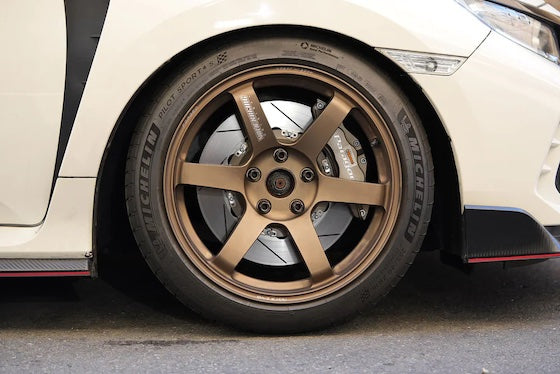
If you are replacing pads, it is worth upgrading your rotors at the same time. The factory cross-drilled rotors are effective but heavy, and their drilling pattern can contribute to resonance. Paragon 2-piece front rotors are a direct bolt-on replacement at 380x36mm. They feature 72 directional ventilation vanes for airflow that runs up to 30% cooler than factory under repeated heavy braking, a slotted surface (rather than drilled) that improves bite and clears gases without creating resonance points, and a fully floating two-piece design with CM-250 high-carbon alloy rings that resist cracking and warping. The hats are CNC-machined from 6061-T6 aerospace-grade aluminium and hard anodised for corrosion resistance. Rear Paragon 2-piece rotors (370x24mm) are also available.
Pairing Paragon rotors with DIXCEL M Type pads is the combination we recommend most for M car owners who want to completely eliminate squeal while improving rotor longevity and reducing unsprung weight. We offer a ready-made Paragon 2-Piece Front Rotors + DIXCEL M Type pad bundle for the G8X platform — check our BMW M2 G87 collection for availability.
Option 3 — Bed In Your Pads Properly
Many M car owners never properly bed in their brakes from new. Bedding-in transfers an even layer of pad material onto the rotor surface, which improves friction consistency and reduces the glazing that causes squeal. The process is straightforward: perform 6-10 moderate stops from 100km/h to 40km/h with 30 seconds of cooling between each stop, followed by a few minutes of light driving to cool the brakes completely. Do not come to a full stop with hot brakes during the bedding process, as this can cause uneven material transfer (pad imprinting) that makes the problem worse.
Option 4 — Full Big Brake Kit Upgrade
For M car owners who track their car regularly and want the ultimate in braking performance, an Alcon big brake kit replaces the entire front brake system with lightweight motorsport-grade calipers and larger rotors. Alcon's forged monobloc calipers weigh roughly half of the factory units, and the kit saves approximately 10kg of unsprung weight from the front axle. This is a serious upgrade for drivers who want both track performance and the ability to run quieter street pad compounds on lighter, more efficient hardware.
Is Brake Squeal on a BMW M Car Dangerous?
No. Brake squeal on the G87 M2, G80 M3, and G82 M4 is a noise issue, not a performance or safety issue. Your brakes are functioning exactly as designed. BMW acknowledges in their own documentation that the M Compound brake system may produce operational noise, particularly under light braking loads, in cold conditions, and in wet weather. The noise has no effect on stopping distance, pedal feel, or brake system integrity.
That said, if the squeal is accompanied by a grinding sensation, vibration through the pedal, or visible rotor damage, those are signs of a different problem entirely and should be inspected by a qualified technician.
What About Carbon Ceramic Brakes?
The optional M Carbon Ceramic Brake package (400mm front / 380mm rear) produces significantly less dust and typically less low-speed squeal than the iron M Compound system. However, BMW's own documentation notes that carbon ceramic brakes can also produce operational noise under light loads and in wet conditions. At over $12,000 AUD from factory, the CCB package is not a cost-effective squeal fix — a pad and rotor upgrade on the standard system delivers better value for most owners.
Frequently Asked Questions
Why do the brakes on my BMW M2, M3 or M4 squeal so much?
The factory M Compound brake pads use an aggressive semi-metallic compound designed for high-temperature performance. At low speeds and light pedal pressure, this compound vibrates against the cross-drilled rotor surface at an audible frequency. The absence of factory anti-squeal shims and the tendency for pads to glaze in daily driving conditions make the problem worse. BMW acknowledges this noise as a normal characteristic of the M brake system.
Is brake squeal on a BMW M car dangerous?
No. Brake squeal is a noise issue only and does not affect braking performance, stopping distance, or safety. If the noise is accompanied by grinding, vibration, or visible rotor damage, have the brakes inspected by a technician.
What is the best brake pad to stop squeal on a G8X M car?
The DIXCEL M Type is our top recommendation for daily drivers. It is specifically formulated for low noise, ultra-low dust, and smooth pedal feel at street temperatures. For owners who want a pad that can handle both spirited street driving and occasional track use, the DIXCEL Z Type offers higher friction output with moderate noise and dust levels.
Will upgrading rotors help with squeal?
Yes. The factory cross-drilled rotors can create resonance that amplifies pad vibration noise. Switching to Paragon 2-piece slotted rotors eliminates the drilling pattern and provides a smoother, quieter contact surface. Paired with a street-compound pad like the DIXCEL M Type, this combination is the most effective way to eliminate squeal entirely.
Will bedding in my pads help reduce squeal?
Proper bedding-in can reduce squeal by ensuring even pad material transfer onto the rotor, which prevents glazing and hot spots. However, bedding alone will not completely eliminate squeal if the factory compound is fundamentally too aggressive for your driving conditions. For the best results, bed in a new set of street-compound pads on fresh or resurfaced rotors.
Do you sell brake upgrades for the BMW M2, M3 and M4?
Yes. At Chicane Australia, we stock DIXCEL brake pads (M Type, Z Type, and other compounds), Paragon 2-piece rotors (front and rear), Paragon + DIXCEL rotor and pad bundles, and Alcon big brake kits for the G87, G80, and G82 platforms. Contact us for help choosing the right setup for how you drive.