
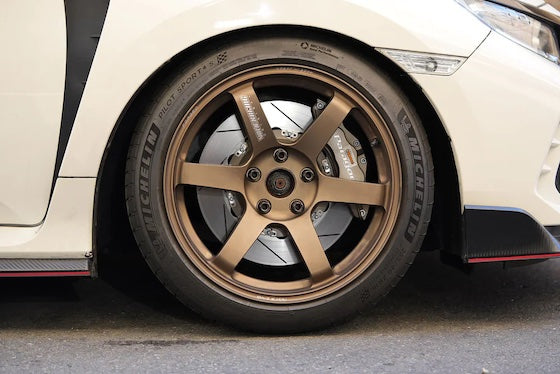

Camber Arms
Adjustable Camber Arms for Lowered and Track-Focused Cars
Camber Arms fix the geometry that goes out the moment a car drops on springs or coilovers. Chicane Australia stocks adjustable rear and front camber arms built with heim joints or high-durometer bushings, so an alignment tech has a real adjustment window instead of whatever the factory arm happens to give. Customers buy them for even tyre wear on a daily driven street car, and for dialling in negative camber for a track day at The Bend or Sydney Motorsport Park.
Shop by Vehicle
Camber arms in this range cover popular Japanese and European platforms, including Subaru WRX and STI, Nissan Silvia and Skyline, Toyota GR86 and Subaru BRZ, plus various Honda and Volkswagen models. Applications vary by chassis code, so check the individual listing for confirmed fitment before ordering.
Shop by Product Type
- Rear camber arms
- Front upper arms with camber adjustment
- Heim (rose) jointed arms for track alignment work
- Rubber or polyurethane bushed arms for street cars
- Front and rear kits sold as pairs
Why Camber Arms
Lower a car past about 25mm and the factory camber bolts usually run out of thread. Camber sits where the suspension puts it, which on a MacPherson strut front end or a multi-link rear often means too much negative on one side and not enough on the other. Adjustable arms give back the range, so camber can be set mild for a daily that needs to survive a set of tyres, or aggressive for a car that lives on track.
We choose to carry brands with accurate thread pitch, decent spherical bearings and finishes that cope with Australian salt and grit. Cheap arms with sloppy tolerances turn every alignment into guesswork, and they are the ones that seize when it comes time to adjust them again.
Fitment & Installation
Most camber arms bolt in using the factory mounting points, though some kits ship with new hardware or bushings that need pressing in. AU-delivered cars should be matched against the listed chassis codes, as some export markets use different subframe and knuckle designs. Rear multi-link setups usually take an hour or two per side; front upper arm jobs vary a lot by platform.
A wheel alignment afterwards is not optional, so factor it into the job. Many installers fit camber arms at the same time as toe arms or bushings, since the subframe area is already apart. Anti-seize on the adjuster threads makes future changes far easier.
Pair with the rest of your build
FAQ
Do I need a wheel alignment after fitting camber arms?
Yes. Changing arm length changes camber and toe together, so the car needs a proper alignment before it goes back on the road.
Will these fit my exact model and year?
Fitment depends on chassis code and sometimes trim. Check the product listing, or send us your build details and we will confirm before you order.
Camber arms or camber plates?
Camber plates adjust at the strut top and suit the front of strut-equipped cars. Camber arms adjust at the arm itself and are the usual answer for multi-link rear ends. Some builds use both.
Do camber arms make the car noisier?
Heim jointed arms are more precise but transmit more road noise and vibration. Bushed arms stay quieter and suit a street car better.
What is the difference between camber arms and control arms?
Camber arms are there to set camber angle. Control arms are the main locating link and are often bought as a replacement for worn factory parts, sometimes with adjustment built in.
Contact Chicane Australia if you need help matching camber arms to your chassis and alignment goals.



SKU: FK8_LOWER_A_ARMS


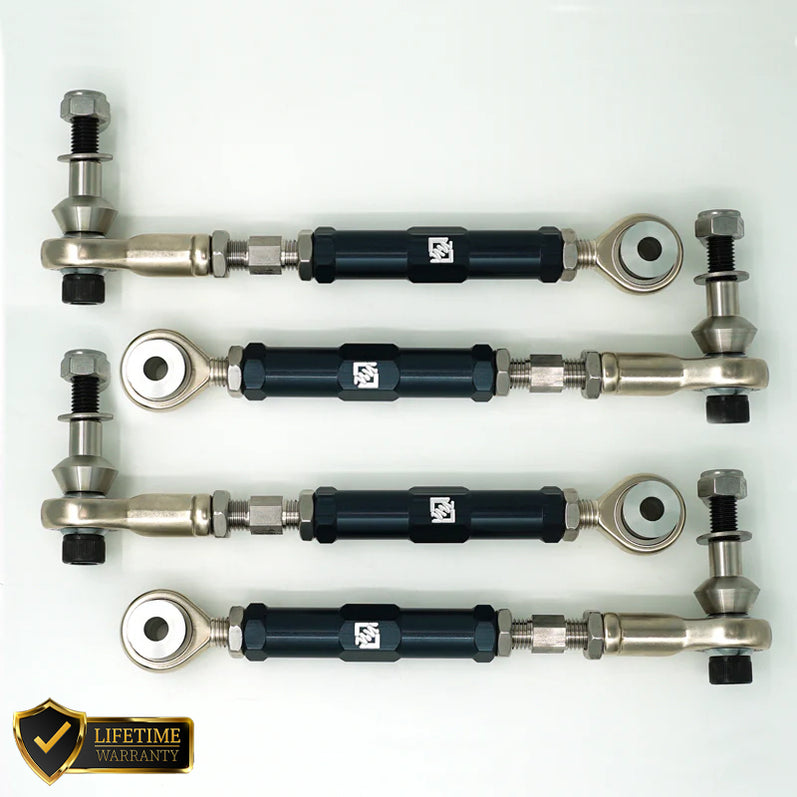

SKU: SS-REAR-CAMBER-F87-NO


