Brake Fluid
High-performance brake fluid for JDM and Euro cars — Alcon Pro-System (UK) and DIXCEL (Japan). DOT 4 to dedicated race-spec, dry boiling points from 300°C to 328°C, all packaged in moisture-resistant metal cans. Four fluids covering everything from a daily-driveable upgrade through to GT3/GT4 endurance racing. Chicane is the Australian distributor for DIXCEL and stocks Alcon Pro-System direct, shipping Australia-wide from the Central Coast, NSW.
Brake fluid is the cheapest brake upgrade you'll ever make. Boiled fluid feels exactly like faded pads. Most pedal-fade complaints we hear come down to fluid that's older than 12 months — moisture absorption has dropped the boiling point from "race-spec" to "average commuter", and on a hot track day it boils before the pads are done. A fresh bottle of the right fluid for $35–50 fixes the most common pedal-feel complaint in the catalogue.
Read more — the four brake fluids we stock, which one suits your driving, dry vs wet boiling point, DOT compatibility & FAQ ▾
The Four Brake Fluids at Chicane
Two brands, four fluids, each with a specific job. Match the fluid to the heat your brakes actually generate — overbuying race-spec fluid for a daily commuter is a waste of money, and underbuying for a tracked car is genuinely dangerous.
Alcon Pro-System PRO-600 — the performance daily fluid
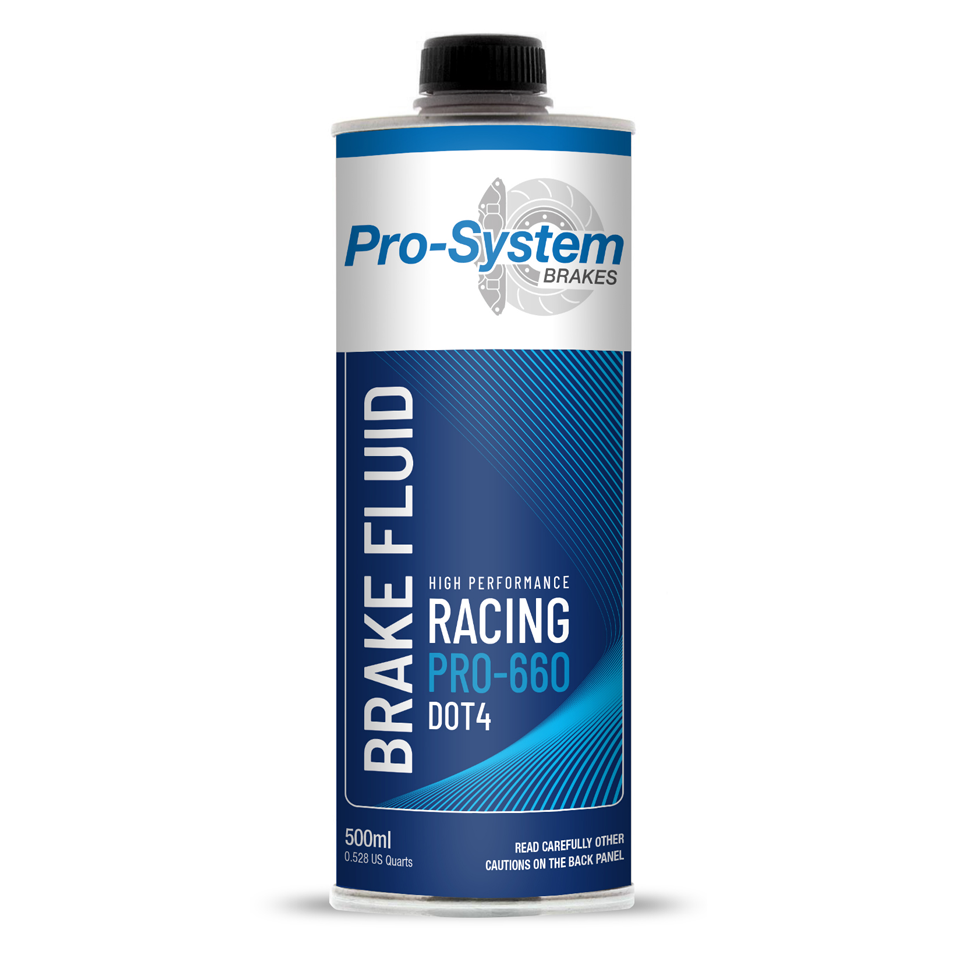
The everyday-and-spirited-driving Alcon fluid. DOT 4, 300°C dry boiling point, 195°C wet boiling point, $44.95 per 500ml metal can. Exceeds US FMVSS No. 116 DOT 4 specifications. Compatible with all DOT 3 and DOT 4 fluids. 24-month shelf life in the sealed metal can (much longer than the typical plastic-bottled fluid). The right answer for a performance street car, a tuned daily, or any spirited-weekend build that doesn't see regular track days.
Alcon Pro-System PRO-660 — the race-spec dual-purpose fluid
The step up for serious track work. DOT 4, 320°C dry boiling point, 195°C wet boiling point, $49.95 per 500ml metal can. 20°C higher dry boiling point than PRO-600, formulated for the extreme thermal loads of professional racing while still being road-legal DOT 4 (exceeds FMVSS No. 116). Used by Alcon's own race programmes. The right answer for a tracked car that's also driven on the road — you don't need to swap fluids between track days and the daily commute.
DIXCEL 328 Racing — the highest dry boiling point in DOT 4
Japanese-engineered race-capable DOT 4. DOT 4, 328°C dry boiling point, $34.95 per 500ml. One of the few racing-dedicated fluids to meet strict FMVSS 116 DOT 4 and SAE J1704 standards. Glycol-based, completely free of tributylamine, which means long-term compatibility with modern ABS and stability control systems. Marketed as the "do-it-all" fluid for dual-purpose track cars — race-capable thermal performance but completely safe and maintainable for daily street driving. The budget-conscious choice if you want race-grade boiling-point numbers without paying Alcon premium pricing.
DIXCEL Ultra Racing — the GT3/GT4 endurance fluid
Dedicated race fluid, top tier of the DIXCEL line. $49.95 per 500ml. Specifically developed for GT3 and GT4 cars in endurance and sprint racing. Premium borate ester base with absolutely no tributylamine — works flawlessly with modern motorsport ABS systems where conventional fluids can cause issues. Designed to maintain a consistently firm pedal feel with minimal "touch" change even under extreme high-temperature conditions. Not the fluid for a street car — this is built for sustained motorsport thermal loads where you'll out-brake rivals into heavy braking zones lap after lap. The right answer for a dedicated track or competition build.
Which Brake Fluid For Your Driving?
Pick by the heat your brakes actually generate, not by which fluid has the highest number on the bottle.
"I drive a tuned daily, no track days"
Alcon Pro-System PRO-600. 300°C dry / 195°C wet is comfortably above what any street car will ever generate. Change every 12–24 months and you'll never have a fluid-related pedal issue.
"I want race-grade specs without race pricing"
DIXCEL 328 Racing. Highest dry boiling point of any DOT 4 we stock (328°C), at $34.95 the cheapest of the four. FMVSS 116 + SAE J1704 compliant, glycol-based, street-safe. Great value for a dual-purpose build.
"I do regular track days on a street-registered car"
Alcon Pro-System PRO-660. 320°C dry boiling point handles sustained track heat without boiling. Still DOT 4, still road-legal, still maintainable as a daily fluid. The sensible middle-ground for street-registered track cars.
"The car is dedicated track or competition only"
DIXCEL Ultra Racing. Built for GT3/GT4 endurance and sprint racing, borate ester base, modern motorsport ABS compatible. The fluid for serious track cars where lap-after-lap consistency matters.
"I'm fitting a BBK and need to bleed the system"
Whichever matches the driving profile above. Every BBK install requires a full fluid flush regardless of brand — buy enough fluid for the complete system bleed (typically 1–1.5L for most cars, more for AWD and BBK installs).
Dry vs Wet Boiling Point — What You're Actually Buying
Two numbers on every brake fluid spec sheet. They mean different things, and the wet number is the one that matters in real life.
Dry boiling point
The boiling point of fresh fluid straight out of the sealed bottle. This is the number marketing uses because it's the bigger one. It's accurate for the day you fit the fluid — and that's about it.
Wet boiling point
The boiling point after the fluid has absorbed roughly 3.7% water by weight, which is what happens in a real-world brake system after about 12 months. Brake fluid is hygroscopic — it pulls moisture out of the atmosphere through hose flex points, master cylinder reservoirs and microscopic gaps in fittings. The wet boiling point is what your fluid is actually capable of by the time you most need it. This is the spec that matters.
Why this matters
A fluid with 320°C dry but 195°C wet might boil at 195°C in a tracked car after a year. A "cheaper" fluid with 280°C dry but 210°C wet would actually handle that car better in service. Manufacturers know wet boiling point is the more useful number, which is why both Alcon Pro-600 and Pro-660 publish it. If a fluid only quotes the dry number, ask why.
The other half of the equation is how fluid is packaged. Metal cans resist moisture absorption far better than plastic bottles — both Alcon fluids and most DIXCEL racing fluids ship in metal precisely because it keeps the fluid closer to its dry boiling point for longer. A fluid in plastic that's been sitting on a shelf for 12 months has already started absorbing moisture before you've even opened it.
DOT 3, 4, 5 and 5.1 — Quick Reference
Quick reference so nobody mixes the wrong fluid into the wrong system.
- DOT 3 — glycol-based, lowest spec, found in basic passenger cars. Intermixes with DOT 4 and DOT 5.1.
- DOT 4 — glycol-based, the performance baseline. All four fluids on this page are DOT 4 or DOT 4-capable. Intermixes with DOT 3 and DOT 5.1.
- DOT 5 — silicone-based, never mix with glycol fluids. Used in some specific applications (military vehicles, some custom builds). Confusing DOT 5 with DOT 5.1 is a real safety issue — read the label twice.
- DOT 5.1 — glycol-based despite the "5" in the name, higher-spec than DOT 4. Intermixes with DOT 3 and DOT 4 safely.
Critical safety message: never mix DOT 5 (silicone) with any other DOT rating. The fluids are chemically incompatible and the result is brake failure. All four fluids on this page are glycol-based and intermix safely with DOT 3, DOT 4 and DOT 5.1.
Bleeding Your Brakes — When and How Often
Brake fluid is hygroscopic — it absorbs moisture from the atmosphere even through a sealed system. After enough moisture absorption the wet boiling point drops to the point where the fluid will boil on hard use. The fix is regular bleeding.
- Daily-driven performance car: every 24 months minimum.
- Spirited weekend driver: every 12 months.
- Regular track day car: between every event, or quarterly at minimum.
- Dedicated track / competition car: before every race weekend.
- After any BBK or caliper install: full system flush, no shortcuts.
Two-person, vacuum and pressure bleeding all work. Pressure bleeding is the cleanest and fastest if you have access to a bleeder kit. AWD cars (R35, STI, Evo, Golf R, RS3) take more fluid and time than RWD cars — budget 1.5L for a proper flush.
Frequently Asked
How often should I change my brake fluid?
Daily-driven street car: every 24 months minimum. Spirited weekend driver: every 12 months. Regular track car: between every event or quarterly. Dedicated race car: before every race weekend. If you can't remember the last time, it's overdue.
Which fluid has the highest boiling point?
Of the DOT 4 fluids, DIXCEL 328 Racing has the highest published dry boiling point at 328°C. Alcon Pro-660 is at 320°C dry / 195°C wet. Alcon Pro-600 is at 300°C dry / 195°C wet. DIXCEL Ultra Racing is a dedicated race fluid in a different category — it's designed for sustained competition use rather than for marketing on boiling-point numbers.
Can I mix different brake fluids?
Yes — DOT 3, DOT 4 and DOT 5.1 are all glycol-based and intermix safely. DOT 5 (silicone-based) must never be mixed with the others. That said, best practice is to fully flush the system when changing fluid brands rather than top up — you don't want old, moisture-laden fluid diluting your fresh fluid.
Why does brake fluid come in a metal can?
Metal cans resist moisture absorption far better than plastic bottles. Brake fluid is hygroscopic and starts pulling moisture out of the air the moment the seal is compromised. A fluid sitting in plastic for 12 months has already begun absorbing moisture before you've opened it. Metal packaging keeps the fluid closer to its dry boiling point and extends shelf life to around 24 months unopened.
What's the difference between DIXCEL 328 Racing and DIXCEL Ultra Racing?
DIXCEL 328 Racing is a DOT 4 glycol-based fluid that meets FMVSS 116 and SAE J1704 — street-safe and intermixable with conventional brake fluids. DIXCEL Ultra Racing is a borate ester race fluid specifically developed for GT3/GT4 cars, designed for modern motorsport ABS systems, and intended for competition use rather than street registration. 328 is the dual-purpose fluid; Ultra Racing is the dedicated race fluid.
Will racing fluid void my car's warranty or affect ABS?
All four fluids on this page are designed to be compatible with modern ABS and stability control systems. The DIXCEL fluids specifically state tributylamine-free formulations to ensure long-term ABS compatibility. The Alcon Pro-System fluids meet US FMVSS No. 116 DOT 4 specifications. For warranty implications, refer to your vehicle manufacturer — some specify only fluids meeting specific OE part numbers.
Do I need a different fluid for my BBK?
Not necessarily, but a BBK install is the right time to upgrade. Most factory fluids are basic DOT 3 or DOT 4 with modest boiling points. If you've spent serious money on a Brembo, Alcon or AP Racing BBK, fit fluid that matches the kit's thermal capacity — Alcon Pro-660 or DIXCEL 328 Racing is the minimum sensible upgrade.
How much fluid do I need for a full flush?
Depends on the car. Most RWD/FWD performance cars take 1 to 1.2L for a proper flush. AWD cars (R35 GT-R, STI, Evo, Golf R, Audi RS3) take 1.3 to 1.5L. BBK installs add another 200–300ml because the larger calipers hold more fluid. Buy enough — you can always store sealed cans for next time, but you can't half-bleed a system.
Supporting Mods
Brake fluid works best when the rest of the system is up to the task:
- Brake Lines — HEL Performance ADR-compliant braided lines. Fluid and lines are the cheapest meaningful pedal-feel upgrade in the catalogue when bought together.
- Brake Pads — DIXCEL Premium, EC, M, ES, S, Z, RA, RE and Specom-β compounds. Race pads need race fluid.
- Brake Rotors — DIXCEL one-piece, Paragon two-piece floating, Alcon motorsport.
- Big Brake Kits — Brembo, AP Racing and Alcon. Every BBK install needs a full system flush.
- DIXCEL — the full Japanese pad, rotor, fluid and shim range under one brand.
- Alcon — UK motorsport calipers, rotors and the Pro-System fluid line.
All four brake fluids at Chicane Australia are 100% genuine, in metal cans for moisture resistance, and shipped Australia-wide from the Central Coast, NSW. Contact us or email sales@chicaneaustralia.com.au if you'd like help matching the right fluid to your car and how you drive.
Filters
Filters