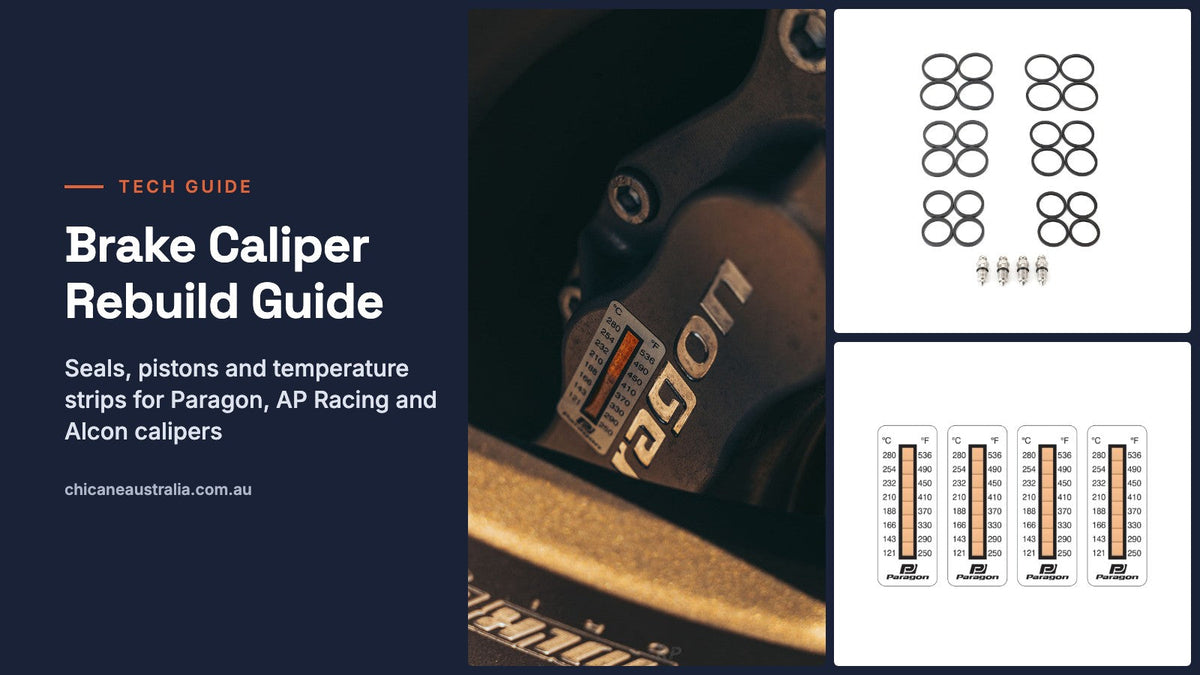
Short answer: a performance caliper needs new seals when it has been overheated, when it leaks or weeps, when a piston sticks, or as planned maintenance on a car that sees regular track use. A seal kit covers a routine rebuild. A piston kit is for when the pistons themselves are marked or corroded, or when you want to upgrade to stainless steel pistons. One kit rebuilds a pair of calipers.
Paragon Performance makes rebuild kits for its own PA015, PA025, PA035 and PA055 calipers, and replacement kits for AP Racing CP9660, CP9665 and CP9668 and Alcon CAR97 and CAR98 calipers. The table further down shows which kit suits which caliper.

What is inside a caliper, and what wears
A fixed caliper like these has opposed pistons on both sides of the rotor. Each piston slides in a bore and is sealed by a pressure seal (also called a piston seal) that holds the brake fluid in. Many calipers add a dust seal or wiper seal at the mouth of the bore to keep dirt out.
The seals are the parts that suffer. Heat travels from the pad through the piston into the caliper body and the fluid. Paragon puts it directly: excessive heat deteriorates caliper seals, dust boots and brake fluid a lot faster. That is why its rebuild kits use high temperature seals, and why it states that high performance brake calipers must be inspected and maintained on a regular basis.
When to rebuild
- After an overheat. If a temperature strip shows the caliper has been into the top band (see below), Paragon says the seals must be replaced as soon as possible.
- Any leak or weep around a piston or the bleed screws.
- Sticking or uneven pistons, often seen as tapered or uneven pad wear.
- Hardened, cracked or burnt dust seals.
- Planned maintenance. How often depends on how hot your brakes run, which is exactly what temperature strips tell you.
Temperature strips: know how hot your calipers get
Paragon Caliper Temperature Indicator Strips are self-adhesive thermal labels that record the peak temperature a caliper has reached. Stick one to a clean, smooth part of the caliper, such as the body near a piston bore. Each indicator turns from orange to black permanently when its temperature is reached. The strips cover 121°C to 280°C in 8 levels, are oil and water resistant, and Paragon quotes 1% accuracy.

Paragon's guide to reading them (for reference only):
| Peak caliper temperature | What it means | What to do |
|---|---|---|
| Under 121°C | Not recorded on the strip. Too cool for optimum braking on track | Nothing |
| 121°C to 166°C | Ideal caliper operating temperature for track | Nothing |
| 188°C to 232°C | On the hot side, but acceptable | Inspect the calipers for leaks after each event |
| 232°C to 280°C | Calipers running too hot | Replace the seals as soon as possible, inspect the whole brake system, and find a way to bring temperatures down |
If you are in the top band, a rebuild fixes the damage but not the cause. Titanium pad shims sit between the pad and the pistons and act as a thermal barrier, and our guide to titanium brake pad shims explains how they work. Fresh brake fluid matters too.
Seal kit or piston kit?
| Seal kit | Piston kit | |
|---|---|---|
| For | Routine rebuilds where the pistons are in good condition | Marked, scored or corroded pistons, or a piston upgrade |
| Paragon PA calipers | Piston seals, dust seals, stainless bleed screws with o-rings, rebuild instructions | Everything in the seal kit plus titanium nitride (TiN) coated stainless steel pistons |
| AP Racing and Alcon | Seals only | Pistons only, so order the seal kit as well |
Paragon recommends replacing the bleed screws whenever the calipers are serviced, which is why its PA kits include them.
On the piston upgrade: Paragon's replacement pistons for AP Racing calipers are machined from stainless steel and TiN coated to protect the sliding surfaces. Its pistons for the Alcon CAR97 are stainless too, replacing the original nickel plated steel pistons. Paragon's reasoning is that stainless steel conducts less heat, so the piston acts as a thermal barrier that helps prevent fluid boiling and brake fade. Both designs have extra machining to minimise contact with the pad.
Which kit suits which caliper
One kit is needed per pair of calipers.
| Caliper | Pistons | Seal kit | Piston kit |
|---|---|---|---|
| Paragon PA015 / PA035 (6 piston) | 27 / 31.8 / 38.1mm | PA015 / PA035 seal kit | PA015 / PA035 piston kit |
| Paragon PA025 (4 piston) | 27mm | PA025 seal kit | PA025 piston kit |
| Paragon PA055 (4 piston) | 38.1 / 41.3mm | PA055 seal kit | PA055 piston kit |
| AP Racing CP9660 (Radi-CAL Pro5000R, 6 piston) | 27 / 31.8 / 38.1mm | CP9660 / CP9665 / CP9668 seal kit | CP9660 piston kit |
| AP Racing CP9665 / CP9668 (Radi-CAL Pro5000R, 6 piston) | 27 / 31.8 / 38.1mm | CP9660 / CP9665 / CP9668 seal kit | CP9665 / CP9668 piston kit |
| Alcon CAR97 Mono6, Y pistons | 27 / 31.8 / 38.1mm | CAR97 Y seal kit | CAR97 Y piston kit |
| Alcon CAR97 Mono6, ZG pistons | 30.2 / 34.9 / 38.1mm | CAR97 ZG seal kit | CAR97 ZG piston kit |
| Alcon CAR98 Mono4 (4 piston) | 31.8mm | CAR98 seal kit | Not offered |
Notes on getting it right
- Alcon CAR97: check your piston size first. The Mono6 was made with two piston sets, called Y and ZG. The smallest piston tells you which: 27mm is Y, 30.2mm is ZG. Measure before you order, or send us the caliper part number.
- AP Racing: one seal kit, two piston kits. The seal kit covers the CP9660, CP9665 and CP9668. The pistons differ, so the CP9660 has its own piston kit and the CP9665 and CP9668 share another. Paragon's AP pistons work with the original AP Racing anti-knockback springs.
- The Alcon CAR97 Y seal kit is also listed by Paragon for Alcon TA6+ and certain CAR89 TA6 calipers.
- PA015 and PA035 share seal and piston kits, but use different crossover tubes and body bolts.
The other small parts worth checking
While the caliper is apart, look at the hardware around the pads. Paragon offers each of these as a spare for its PA calipers:
- Abutment plates. Stainless wear plates that stop the pad backing plate digging into the aluminium caliper body, which can cause sticking and uneven pad wear. PA015 / PA035, PA055 / PA025.
- Anti-knockback springs. Hard cornering can deflect the hub and rotor enough to push the pistons back into their bores, giving a long first pedal. These springs put a light preload behind the pistons to reduce it. PA015 / PA035, PA025, PA055.
- Anti-rattle clips and pad retainers. They hold a small preload on the pad to stop it moving in the caliper. Paragon suggests inspecting spring clips periodically and replacing them when needed. PA055 / PA025 clip kit, Alcon CAR97 clip kit, PA015 / PA035 retainer kit, AP Racing CP9665 / CP9668 retainer kit.
- Crossover tubes and body bolts. Stainless crossover pipes and corrosion resistant body bolts are available for each PA caliper in the Paragon Performance range.
Rebuild basics
Paragon's PA kits include its caliper rebuild instructions as a PDF, and those are the reference for the job. The general shape of a rebuild is the same for any fixed caliper:
- Remove the caliper and pads, and note which piston size sits in which bore. Staggered calipers have the smallest pistons at the leading end.
- Remove the pistons and old seals without scratching the bores or seal grooves.
- Clean everything with fresh brake fluid or brake cleaner and inspect the bores and pistons. Marked pistons get replaced.
- Fit the new seals, lubricated with clean brake fluid, and refit the pistons squarely.
- Fit new bleed screws, refit the caliper, bleed the system and check for leaks before driving.
Brakes are a safety system. If you have not rebuilt a caliper before, have a qualified workshop do it.
FAQ
How many kits do I need?
One per pair of calipers. A front axle is one kit.
Do I need new pistons every time?
No. If the pistons are clean and unmarked, a seal kit is enough.
Are these kits for factory sliding calipers?
No. They suit the Paragon, AP Racing and Alcon calipers named above. For rebuilding OEM calipers, see our Frenkit caliper rebuild kits.
How do I know which Paragon caliper I have?
Check the paperwork for your Paragon big brake kit, count the pistons and measure them against the table above, or send us a photo.
Where do I stick a temperature strip?
On a clean, smooth area of the caliper, such as the body near a piston bore. Fit a new strip once the old one has recorded a temperature you have acted on.
Need help choosing a rebuild kit? Contact our team at sales@chicaneaustralia.com.au.