
Understanding Your WRX & STI Exhaust System
The exhaust system on your WRX or STI is one of the most impactful modifications you can make — affecting power, sound, weight, and how well your turbo spools. But the exhaust isn't one single part. It's a series of components, each serving a different purpose, and understanding what each piece does is the key to choosing the right upgrade for your goals and budget.
This guide walks through every component of the Subaru WRX and STI exhaust system, explains what each upgrade actually does in terms of performance, and helps you decide where to start based on your power level and how you use the car.
The Exhaust Path — Component by Component
Headers (Exhaust Manifold)
The headers bolt directly to the cylinder head and collect exhaust gases from each cylinder into a single flow path leading to the turbo. On a turbocharged Subaru, the headers also include the up-pipe — the section between the header collector and the turbo inlet.
Subaru's EJ engine is a boxer (flat) layout with two cylinder banks, which gives you a choice between two header designs:
Unequal length (UEL) headers have runners of different lengths due to the boxer layout. This creates the distinctive Subaru "rumble" that the brand is famous for. UEL headers sacrifice a small amount of exhaust scavenging efficiency for that signature sound. If the Subaru rumble matters to you, UEL headers are the way to go. The KORSH UEL 3-bolt header and up-pipe fits WRX (1994–2014), STI (2002–2021), Liberty GT, and Forester XT.
Equal length (EL) headers use tuned runners that equalise the exhaust pulse timing from each cylinder. This improves exhaust scavenging and smooths out the exhaust flow into the turbo, resulting in slightly better spool and a more even power delivery. The trade-off is the loss of the characteristic rumble — an EL-equipped Subaru sounds more like a conventional turbo four-cylinder. The KORSH EL 3-bolt header and up-pipe covers the same fitment range.
Twin scroll headers are designed for twin scroll turbo applications. They separate exhaust pulses from cylinders that would otherwise interfere with each other, feeding them into dedicated scrolls on the turbo. This improves spool and reduces exhaust gas reversion. The KORSH twin scroll header and up-pipe is the solution for twin scroll turbo setups on the EJ platform.
Performance impact: Aftermarket headers with a high-flow up-pipe typically contribute 5–15whp on a stock turbo WRX/STI, with the gains coming primarily from improved exhaust gas flow into the turbo. The real benefit is faster turbo spool — the turbo sees cleaner, faster-flowing exhaust gas and responds more quickly to throttle input.
Downpipe
The downpipe connects the turbo outlet to the rest of the exhaust system. On the factory WRX and STI, the downpipe includes a catalytic converter and is typically the most restrictive section of the entire exhaust. Replacing it with a larger-diameter aftermarket downpipe is one of the single most effective exhaust modifications for a turbocharged Subaru.
Catted downpipes include a high-flow catalytic converter. They reduce emissions while still flowing significantly more than the factory unit. A quality high-flow cat reduces the smell and environmental impact of running without a cat while giving up very little in terms of peak power compared to catless. KORSH catted downpipes are available for the WRX/STI GD/GG and WRX GE/GH/GR/GV, STI GR/GV/VA, Forester XT, and Liberty GT. For the WRX VA, Levorg, and Forester XT (SJ), the KORSH catted J-pipe is the correct fitment.
Catless downpipes remove the catalytic converter entirely for maximum exhaust flow. They offer a small power advantage over catted alternatives (typically 5–10whp at most) but produce a stronger exhaust smell, are louder, and are not legal for road use in most Australian states. KORSH catless downpipes are available for the WRX/STI GD/GG and WRX GE/GH/GR/GV, STI GR/GV/VA, Forester XT, and Liberty GT.
Performance impact: A downpipe upgrade on a stock turbo WRX/STI typically adds 15–25whp with a proper tune. The gains are larger on cars with other supporting modifications. The downpipe is the single most restrictive component in the factory exhaust — replacing it gives the turbo a clear exit path, which improves spool, reduces exhaust gas temperature, and allows the tuner to run more efficient ignition timing.
If you're upgrading the downpipe but keeping the factory cat-back for now, the KORSH 3-inch downpipe to OEM cat-back adapter bridges the gap between the larger aftermarket downpipe and the smaller factory mid-pipe.
Important: A downpipe upgrade requires an ECU tune. Running an aftermarket downpipe on the factory map will trigger check engine lights and can cause the engine to run lean. If you're fitting a Blouch turbo upgrade, the downpipe should be upgraded at the same time.
Cat-Back Exhaust
The cat-back replaces everything from the catalytic converter (or downpipe outlet) to the exhaust tips. This includes the mid-pipe, resonator (if equipped), muffler, and tips. A cat-back exhaust is the most common first exhaust modification because it changes the sound significantly, adds a modest power improvement, and doesn't require an ECU tune on most setups.
Performance impact: A cat-back exhaust on its own typically adds 5–15whp on a stock turbo WRX/STI. The gains are modest because the factory cat-back is less restrictive than the factory downpipe. The primary benefit is sound — a quality aftermarket cat-back transforms the character of the car. Secondary benefits include weight savings (especially with titanium systems) and reduced backpressure that helps exhaust gas temperatures.
KORSH cat-back systems are available in both stainless steel and titanium:
WRX VB (2022+): Stainless steel cat-back · Titanium cat-back
WRX/STI GV/VA: Stainless steel cat-back · Titanium cat-back
BRZ / 86 / GR86: Cat-back exhaust
Tune required? A cat-back exhaust alone generally does not require a tune on a stock turbo car. However, if you're already running an aftermarket downpipe or turbo upgrade, your tuner should account for the full exhaust system.
Turbo-Back Exhaust
A turbo-back system replaces everything from the turbo outlet to the tips in one kit — downpipe, mid-pipe, and cat-back. This is the most comprehensive exhaust upgrade and delivers the most performance benefit because it eliminates every restriction in the exhaust path simultaneously.
Performance impact: A full turbo-back system with a tune typically adds 25–40whp on a stock turbo WRX/STI compared to the completely stock exhaust. On cars with a Blouch turbo upgrade and supporting fuel modifications, the gains from a turbo-back are even more significant because the larger turbo can take full advantage of the reduced backpressure.
KORSH turbo-back systems are available in stainless steel and titanium:
WRX GH/GR / STI GR (hatch): Stainless steel turbo-back
WRX GV / STI GV/VA: Stainless steel turbo-back · Titanium turbo-back
WRX VA: Stainless steel turbo-back · Titanium turbo-back
For a complete engine-to-tip solution with tuning support, the Cobb/KORSH engine-back package bundles a KORSH UEL header and exhaust with a Cobb Accessport for WRX GV/GR and STI GV/GR/VA — everything you need in one kit.
Tune required? Yes, always. A turbo-back includes a downpipe, which changes the exhaust flow characteristics enough to require a tune. Budget for a professional ECU tune when purchasing a turbo-back system.
Stainless Steel vs Titanium
Most quality exhaust systems are available in both materials. The choice comes down to your priorities:
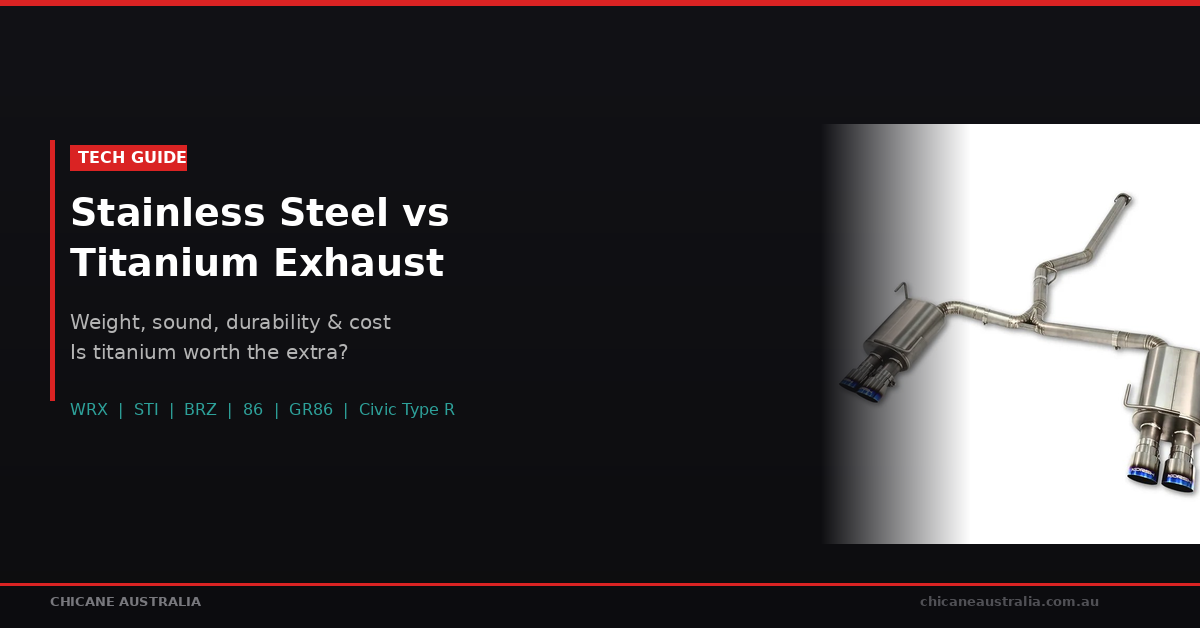
Stainless steel is the standard choice. It's durable, corrosion-resistant, and significantly more affordable than titanium. A stainless steel exhaust will last the life of the car under normal conditions. Sound characteristics are deep and resonant. For the majority of street-driven WRX and STI builds, stainless steel is the practical choice.
Titanium is the premium option. It's typically 40–50% lighter than an equivalent stainless steel system, which is meaningful weight savings — a full titanium turbo-back can save 10–15kg compared to stainless. Titanium produces a sharper, more metallic exhaust note that many enthusiasts prefer. It also develops the distinctive blue/purple heat discolouration over time. The trade-off is cost — titanium systems are significantly more expensive. For track-focused builds, time attack cars, and builds where every kilogram matters, titanium is worth the investment.
Catted vs Catless — What You Need to Know
This is one of the most common questions when choosing a downpipe or turbo-back system.
Catted (high-flow catalytic converter): A high-flow cat is less restrictive than the factory unit but still performs its emissions function. Modern high-flow cats flow very well — the power difference between a quality catted downpipe and a catless one is typically only 5–10whp. Catted downpipes produce less exhaust smell, are quieter at idle, and keep the car closer to emissions compliance. For street-driven cars, a catted downpipe is the sensible choice.
Catless: Removing the cat entirely gives maximum exhaust flow and a small power advantage. However, catless downpipes produce a noticeable sulphur smell (especially when cold), are louder at idle, and are not legal for road registration in most Australian states. Catless setups are best suited for dedicated track or competition vehicles.
For most builds, a catted downpipe with a quality high-flow cat is the right balance of performance, sound, and practicality.
Which Exhaust Upgrade for Your Power Level?
Stock Turbo, Street Focus — Start Here
A cat-back exhaust is the ideal first modification. It changes the sound dramatically, adds modest power, and doesn't require a tune. A KORSH stainless cat-back for the WRX VB or a KORSH cat-back for the GV/VA is the lowest-risk, highest-reward exhaust upgrade for a stock turbo WRX or STI that you drive daily. Pair it with quality brake pads (DIXCEL Z-type or ES-type) for a well-rounded daily upgrade.
Stock Turbo, Want More Power — Add a Downpipe
Adding a KORSH catted downpipe to your cat-back setup (or going straight to a turbo-back) unlocks the biggest gains available on a stock turbo. Budget for an ECU tune — this is mandatory. With a turbo-back and a tune, you're getting close to the maximum power your stock turbo can deliver. At this point, start thinking about larger injectors (Injector Dynamics ID1050x) and an uprated fuel pump if you want to run E85.
Turbo Upgrade — Full Turbo-Back is Essential
If you're fitting a Blouch Dominator turbo, a full turbo-back exhaust is not optional — it's essential. The larger turbo needs a clear exit path to perform. Running a Blouch turbo on the factory exhaust leaves significant power on the table and can cause elevated exhaust gas temperatures. A KORSH turbo-back or titanium turbo-back, combined with the right fuel system (Radium fuel rail, regulator, and surge tank) and injectors (Injector Dynamics), gives your tuner the room to extract the full potential of the turbo upgrade safely.
Headers — The Final Piece
Aftermarket headers are typically the last exhaust component to upgrade. They offer modest peak power gains but improve spool response and broaden the torque curve. If you've already done the downpipe, cat-back, and turbo upgrade, a set of KORSH UEL headers for the classic rumble, EL headers for maximum efficiency, or twin scroll headers for twin scroll turbo setups complete the exhaust path and remove the last restriction.
Do I Need a Tune?
This depends on what you've changed:
Cat-back only: Generally no tune required on a stock turbo car. The factory ECU can adapt to the slightly reduced backpressure.
Downpipe or turbo-back: Yes, always. The change in exhaust flow is significant enough that the factory map cannot compensate safely. Running an aftermarket downpipe without a tune risks lean conditions and detonation.
Headers: Yes. Aftermarket headers change exhaust gas flow characteristics at the turbo inlet, which affects boost control and air-fuel ratios.
Any combination with a turbo upgrade: Absolutely yes. A professional tune is mandatory and should be done on a dyno with a wideband oxygen sensor to ensure safe air-fuel ratios and ignition timing across the entire RPM range.
Supporting Modifications
An exhaust upgrade is often the start of a broader build. Here's what else to consider at each stage:
With a cat-back: Quality brake pads (DIXCEL), alignment check, and enjoy the sound.
With a turbo-back + tune: Larger injectors (Injector Dynamics ID1050x), uprated fuel pump, and an uprated clutch if you're on a manual transmission. Consider Hardrace adjustable arms and an alignment to make the most of the extra power through corners.
With a turbo upgrade + turbo-back: Full supporting fuel system (Radium fuel rail, regulator, and surge tank for E85 builds), front-mount intercooler, uprated clutch, and a professional dyno tune. Read our Blouch turbo comparison guide for detailed turbo selection advice.
Browse the full exhaust range: KORSH Subaru WRX/STI Exhaust Systems · All KORSH Products. Supporting mods: Blouch Turbo Upgrades · Injector Dynamics · Radium Fuel Systems · DIXCEL Brakes · Hardrace Suspension
Need help choosing the right exhaust for your WRX or STI? Contact us or email sales@chicaneaustralia.com.au — we can help you spec the right system for your power goals and budget.