

If you own a Civic Type R, you've already won. Both the FK8 and FL5 are genuinely brilliant front-wheel-drive hot hatches — the FK8 won track tests against cars costing twice as much, and the FL5 has been called the best FWD car ever built. But once you start looking at modifications, the two cars diverge in ways that aren't obvious from the spec sheet.
This guide walks through the real mechanical differences between the FK8 (2017–2021) and FL5 (2023+), what parts carry over and what doesn't, and how the modification path differs between the two platforms. Whether you're choosing which Type R to buy or wondering whether your FK8 build parts will transfer to a new FL5, this is the breakdown.
Same Engine, Different Tune
Both the FK8 and FL5 use the same fundamental engine: the K20C1, Honda's 2.0L turbocharged inline-four with DOHC i-VTEC. Same block, same heads, same direct injection, same compression ratio. The block is one of the strongest four-cylinder platforms Honda has ever built and that doesn't change between generations.
What changed for the FL5 is everything around the engine. Honda fitted a redesigned turbocharger with optimised blade count and shape, a freer-flowing exhaust system with an active exhaust valve, increased intake flow rate, and a 48% larger radiator opening. The result is a modest 7kW / 20Nm bump in US-spec (228kW / 400Nm on the FK8 vs 235kW / 420Nm on the FL5) — but the more important change is consistency. The FL5 holds power under sustained load far better than the FK8, which is notoriously prone to heat soak when pushed hard.
European and Japanese FL5s get the full-fat tune at 243kW and 420Nm. Australian cars run the JDM-spec K20C1 with the higher output figures. That's relevant for modification planning — your starting point is closer to the European tune than the detuned US version.
The MAF Sensor Difference Nobody Talks About
Here's a detail that catches a lot of FK8-to-FL5 upgraders by surprise: the two cars use different MAF sensor technology.
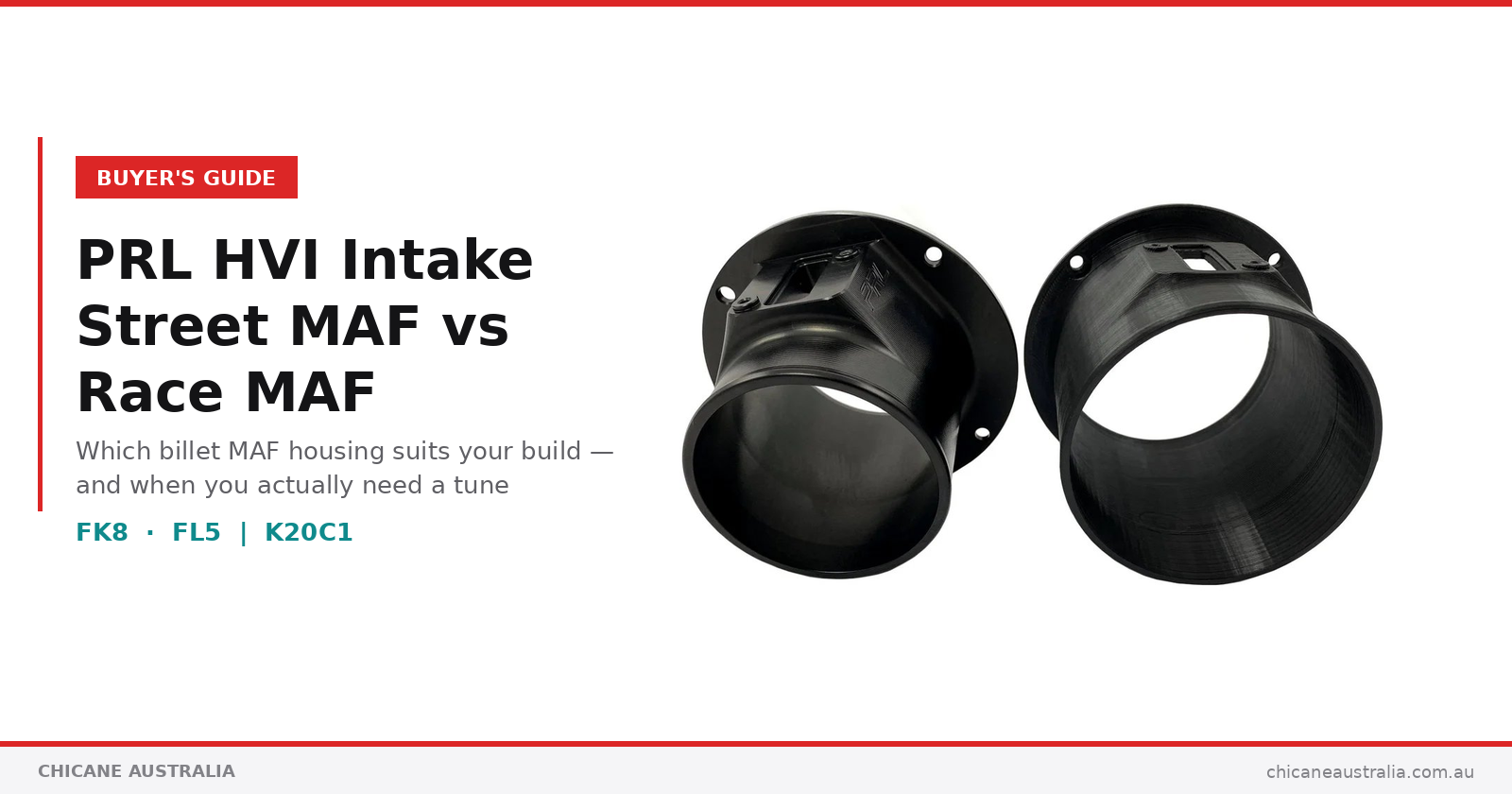
The FK8 uses a voltage-output MAF sensor with a 5-volt reading limit. Once airflow demand exceeds what the sensor can read within that 5-volt window, the ECU is effectively blind to additional airflow and the engine hits a tuning ceiling. On a stock FK8 it's surprisingly easy to max out the MAF — even a modest tune can push the car close to the sensor's limit, which is why almost every serious FK8 build runs the PRL HVI with the Race MAF housing or a Hondata-calibrated alternative sensor.
The FL5 switched to a frequency-output MAF sensor, which has a significantly wider effective reading range than the voltage-based unit. The FL5 can be tuned harder before running into MAF limits, meaning bolt-on builds and moderately tuned setups can stay on the factory MAF much longer. The practical consequence: FL5 owners can often run the Street MAF housing in builds where an FK8 owner would already need the Race MAF.
This is a real-world tuning advantage of the FL5 platform that doesn't show up in the brochure but matters enormously when you start chasing power.
Chassis and Body — What Changed
The FL5 is built on the 11th-generation Civic platform, which is a meaningful step forward from the FK8's 10th-gen base. The wheelbase grew by 35mm (to 2,735mm), tracks widened (25mm front, 19mm rear), and Honda added more bonding points throughout the chassis to increase structural rigidity. Rear body rigidity is up 15%. The FL5 also uses lower suspension arms with 16% better camber rigidity for sharper turn-in.
Despite the larger footprint, the FL5 is only marginally heavier — 1,446kg vs the FK8's 1,416kg. Honda offset the chassis growth with an aluminium bonnet (43% lighter than the FK8's steel unit) and an 18% lighter flywheel that genuinely transforms the engine's responsiveness.
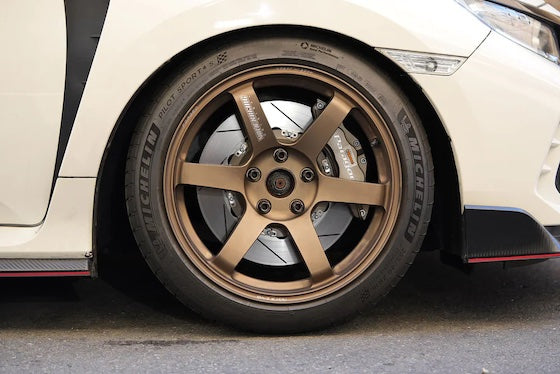
The wheels shrunk: FK8 ran 20s, FL5 runs 19s. Counter-intuitive on a track car, but Honda did this deliberately — smaller wheels meant more tyre sidewall, less unsprung weight, and better ride compliance over Australian roads. The 19" wheels also allow a wider range of tyre choices.
Drivetrain — What's Identical and What Isn't
Both Type Rs use a 6-speed manual transmission with the same individual gear ratios, but the FL5 final drive ratio was shortened from 4.111 to 3.842. That sounds counter-intuitive (the FL5 has a longer final drive), but combined with the lighter flywheel and revised rev-matching software, the result is faster, more responsive shifts and better cruise refinement.
The helical limited-slip differential is the same fundamental design across both platforms. Brakes are similar in spec — both run Brembo four-piston front calipers with two-piece rotors, though the FL5's rotor design is revised for better cooling under sustained track use.
Aftermarket Parts — What Carries Over?
The honest answer for most aftermarket parts is: not as much as you'd hope. The K20C1 engine internals are identical, so anything internal-engine (rods, pistons, valve train) is fully cross-compatible. But almost everything that bolts to the engine bay, the chassis, or the exhaust system has been re-engineered for the FL5 packaging.
Intercoolers: Not interchangeable. FK8 intercoolers (including PRL's FK8 unit) use different mounting points than the FL5. The FL5 also has a much larger gap between radiator and turbo, allowing a thicker core — PRL's FL5 intercooler is rated to 450kW (600hp) vs the FK8's 410kW (550hp) rating, partly because they can fit more core volume.
Intake systems: Not interchangeable. The airbox and inlet routing differ between platforms, so the PRL HVI for FK8 and PRL HVI for FL5 are separate kits with different MAF housings (which themselves use different sensor technology, as covered above).
Charge pipes: Not interchangeable. Different routing on each platform.
Downpipes: Not interchangeable. Different mounting bolt patterns and exhaust routing.
Turbocharger inlet pipes: Different. The FL5 inlet pipe is a different shape and routing to suit the FL5 turbo position.
Turbo upgrades (P700, P600): The PRL P700 drop-in turbo upgrade fits both FK8 and FL5 — same compressor housing, same turbine housing dimensions, just bolts up. This is one of the rare big-ticket items that genuinely carries over.
Engine mounts: Not interchangeable. The FL5 uses a different rear mount geometry, which is why PRL released a dedicated FL5 billet rear engine mount.
Suspension: Largely platform-specific. Coilovers, control arms, and most chassis components are different between FK8 and FL5.
Brakes: Pad shape is similar but rotor sizes have been updated. Check fitment before assuming carryover.
Aero: Completely different. APR Performance sells separate FK8 and FL5 wings, splitters, and diffusers for this reason.
The short version: if you're upgrading from FK8 to FL5 thinking you'll carry your modifications across, plan on selling most of them and starting fresh. The exception is anything internal-engine and the turbo upgrade itself.
Build Path Differences — How Modifying Each Platform Differs
The FK8 is the more straightforward platform to modify because it's been on the market for nearly a decade and every fitment, every tune file, every dyno curve has been mapped out. The biggest weaknesses (heat soak, intake restriction, factory rubber charge pipes) are well-documented and well-solved. A typical FK8 build follows a predictable path:
FK8 Stage 1 (no tune): PRL Intercooler + HVI Street MAF + Charge Pipes. Addresses the platform's biggest weakness (heat soak) without needing a tune.
FK8 Stage 2 (tuned bolt-ons): Add downpipe + front pipe + Hondata FlashPro tune. Switch to HVI Race MAF housing. 260kW at the wheels territory.
FK8 Stage 3 (built fuel system): Add titanium inlet pipe + flex fuel kit + supporting fuel system upgrades. 300kW at the wheels on E85.
FK8 Stage 4 (P700 build): Full supporting mods + P700 turbo + built engine considerations. 370–450kW at the wheels.
The FL5 build path is similar but a few things change. The frequency-output MAF means you can stay on the Street MAF housing longer. The factory intercooler is better than the FK8's, so the upgrade is less urgent (though still worthwhile for any tuned car). The active exhaust valve in the FL5's factory exhaust complicates catback choice — some aftermarket exhausts require deletion of the valve, which can throw codes without a tune to suppress them.
The FL5 also has the advantage of being a current platform, so new products are still being developed for it. The FK8 aftermarket is mature and stable; the FL5 aftermarket is still expanding rapidly. If you want every possible part option from every possible vendor, the FK8 currently has more choice. If you want the latest tech, the FL5 is getting it first.
Which Platform Suits Which Builder?
Buy the FK8 if: You're price-sensitive (FK8s sell for roughly half the price of a new FL5), you want maximum aftermarket choice, you don't mind the mature platform, or you want to start with a known quantity. The FK8 is also a quicker car to genuinely "wake up" with mods — heat soak is the biggest factory weakness and once you fix it the car transforms.
Buy the FL5 if: You want the better starting point, you value the chassis improvements (stiffer body, wider tracks, lighter flywheel), you want the frequency-output MAF advantage for tuning headroom, or you simply want the latest and best version of the platform. The FL5 is also the more refined daily driver — better ride, better interior, fewer compromises.
If you already own an FK8 and are considering upgrading: the FL5 is genuinely better, but it's evolution rather than revolution. Don't expect your existing mods to transfer — plan on selling most of them. The big question is whether the chassis improvements and tuning headroom justify the price gap, and that depends on your build goals.
Available Now at Chicane Australia
Chicane Australia stocks the full range of performance parts for both platforms — including the complete PRL Motorsports range as Australia's authorised dealer. Browse the platform-specific collections:
PRL Motorsports for Honda Civic Type R FK8 (2017–2021)
PRL Motorsports for Honda Civic Type R FL5 (2023+)
For the rest of the build — exhausts, brakes, aero, suspension, fuel system — pair with KORSH Exhausts, APR Performance Aero, DIXCEL Brakes, Paragon Rotors, Hardrace Suspension, and Injector Dynamics fuel injectors.
Not sure which platform suits your goals, or working out which parts to start with? Contact us or email sales@chicaneaustralia.com.au — we know both platforms inside-out and we'll help you spec the right combination for your power target.