

The PRL Motorsports High Volume Intake System (HVI) is the best-selling intake on the Honda Civic Type R platform for good reason — it actually delivers. But every kit ships with a choice of two billet MAF housings, and that choice catches a lot of owners out. Get it wrong and you either leave power on the table or trigger check engine lights the moment the car starts up.
This guide breaks down exactly what the Street MAF and Race MAF housings do, who each one is for, and how to pick the right one for your FK8 or FL5 build. Spoiler: if you're not already running over 450 horsepower (or planning to), the Street MAF is almost certainly the right answer.
What is a MAF Housing — and Why Does It Matter?
The MAF (Mass Air Flow) housing is the section of the intake tract that holds the MAF sensor and shapes the airflow over it. The sensor itself measures the volume and density of air entering the engine, and the ECU uses that data to calculate the correct fuel injection quantity for every cylinder fire. Get bad MAF data, and the ECU runs the wrong fuel trims — meaning either too rich (loss of power, fouled plugs, codes) or too lean (engine damage risk).
The factory FK8 and FL5 MAF housings are good — but small. As airflow demand climbs with bigger turbos, more boost, or supporting mods, the factory housing becomes a flow restriction. PRL solved this with two billet aluminium replacement housings, each profiled to keep the MAF sensor reading correctly while flowing significantly more air than the factory unit.
Street MAF Housing — No Tune Required
The Street MAF housing is the default option in the PRL HVI kit. It's calibrated to maintain factory fuel trims with the stock ECU map — meaning you can bolt the entire HVI system onto your car, drive it home from the install, and never need a tune or recalibration to keep things running properly.
What it gives you over the factory intake is the rest of the HVI system: the rotomolded HDPE airbox, the 6" cone filter, the velocity stack inside the airbox, and on the FL5 the secondary cool air duct from the fender well. The Street MAF housing itself doesn't dramatically increase airflow volume over the factory housing — it's the broader intake system doing the heavy lifting.
The end result is a noticeable improvement in throttle response, intake sound, and consistency under sustained driving — without changing fuelling behaviour, idle quality, or cruise drivability. It's also the only option Honda warranty arguments will (begrudgingly) tolerate, since the ECU is still running the factory map.
Choose the Street MAF if:
- You're running stock turbo with bolt-on supporting mods
- You're under 400 wheel horsepower (or planning to stay there)
- You're not running a tune (Hondata FlashPro, KTuner, or similar)
- You want the simplest possible install with no follow-up work
- You value daily-driver reliability and a factory-like cruise
Race MAF Housing — The Big Power Solution
The Race MAF housing is the largest MAF housing available for the platform. It uses a larger volute (the section that shapes airflow over the sensor) with the MAF flange optimally located to keep fuel trims stable at high airflow volumes. PRL's own development testing shows it supports between 600 and 650 horsepower using the factory MAF sensor — which is the practical upper limit of what the K20C1 platform can produce on a built motor and big turbo.
Here's the critical detail every buyer needs to understand: the Race MAF housing flows roughly 45-50% more air volume than the Street MAF or factory housing. That's a significant change in the air-to-voltage relationship the ECU is calibrated for. Without a tune to recalibrate the MAF transfer function, the ECU will read incorrect airflow values from the moment you start the car — typically resulting in fuel trim errors, rough idle, hesitation, check engine lights, and in the worst case, dangerous lean conditions under load.
The Race MAF is engineered to work with a tune. It's not a "drop in and see what happens" upgrade.
Choose the Race MAF if:
- You're already running a tune solution (Hondata FlashPro, KTuner, or similar)
- You're targeting over 450 wheel horsepower
- You're planning a big-turbo build (P700 or similar)
- You have a tuner lined up who can recalibrate the MAF transfer table
- You're running E85 or flex fuel where airflow demand is higher
PRL's own guidance is that the Race MAF housing is intended for customers looking to make over 450 horsepower. Below that, the Street MAF is sufficient and the Race MAF gains are theoretical rather than practical.
The "Wrong MAF" Problem — What Actually Goes Wrong
The most common Customer Service ticket on the PRL HVI is some variant of "I just installed it and the car runs terribly." Nine times out of ten, the problem is the wrong MAF housing for the build.
Race MAF installed without a tune: The ECU reads airflow values that don't match its calibration, so fuel trims go wildly off. You'll typically see one or more of: rough idle, hesitation under part-throttle, the engine running rich (smoke from the exhaust, fuel smell), check engine lights for fuel trim DTCs, or in some cases a hard lean under load that could damage the engine. The fix is either swap to the Street MAF housing, or get the car tuned immediately.
Street MAF installed on a tuned, big-power build: Less catastrophic but still a problem. The Street MAF becomes the limiting restriction once airflow demand exceeds what it can flow. You'll see fuel trim corrections at the top of the rev range, MAF voltage maxing out before the ECU expects it to, and ultimately a power ceiling you can't tune past without changing the housing. The fix is swap to the Race MAF and recalibrate.
Both of these problems are avoidable with the right housing choice up front.
Can You Run the Race MAF Without a Tune?
No. Every PRL document on the Race MAF housing is explicit that it requires a tune to function correctly. Some owners have tried running it briefly without a tune to "see what happens" and the results are universally bad — at minimum a check engine light, at worst dangerous fuel trim errors that could damage the engine.
If you're not ready to commit to a tune (the cost, the tuner relationship, the ongoing recalibration when you add mods), don't buy the Race MAF housing. The Street MAF is the right choice. You can always upgrade the housing later when you're ready to tune the car — the rest of the HVI components stay.
FK8 vs FL5 — Are the MAF Housings Different?
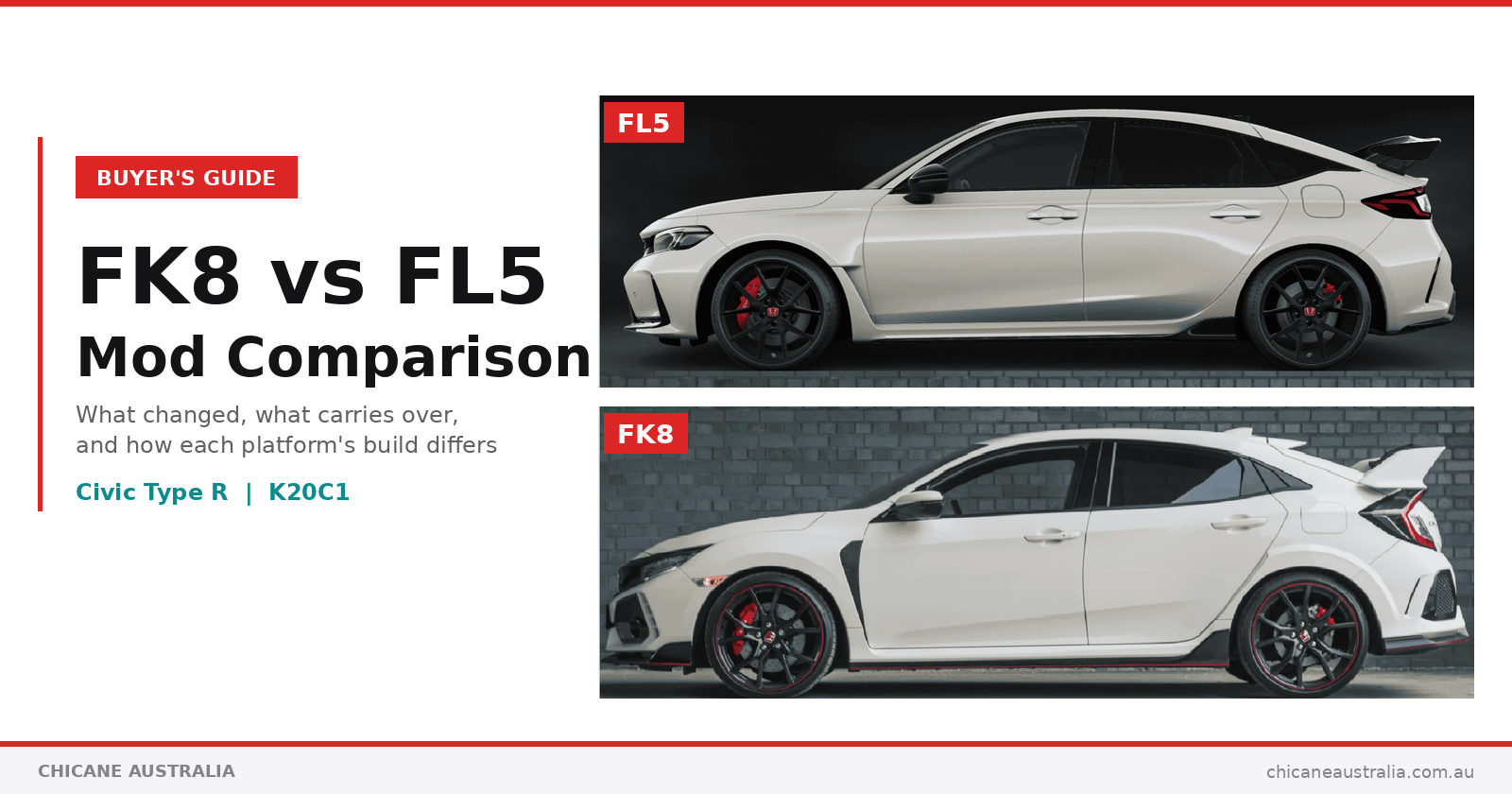
Yes. The FK8 HVI and FL5 HVI use slightly different MAF housing designs because the airbox and intake routing are different between the two platforms. They are not interchangeable. When you order the PRL HVI, make sure you're ordering the correct kit for your chassis — the FK8 kit fits 2017–2021 Civic Type R, the FL5 kit fits 2023+ Civic Type R.
The Street vs Race MAF logic is identical across both platforms — the same decision framework applies regardless of which Civic Type R you have.
Pairing With Other PRL Components
The MAF housing choice affects what other PRL parts make sense for your build. A few quick rules:
If you're running the Street MAF, the PRL Intercooler, Charge Pipe Kit, and Race Downpipe + Front Pipe are all still excellent additions. They don't push you into Race MAF territory on their own — even with all three, most cars stay under 400whp on a tuned but stock-turbo setup. You can add these progressively without changing the MAF housing.
If you're running the Race MAF, you almost certainly want the rest of the PRL induction stack: titanium turbocharger inlet pipe (to remove the factory inlet restriction), upgraded charge pipes, and downpipe + front pipe. The Race MAF is intended for builds where every other intake restriction is also addressed.
If you're going P700 turbo, the Race MAF is required, not optional. The factory turbo can't make the kind of airflow that justifies the Race MAF, but the P700 absolutely can — and at that power level the Street MAF will be your ceiling.
Quick Decision Summary
If you're still not sure, here's the short version:
Stock turbo, bolt-ons, daily driver → Street MAF. End of story.
Stock turbo, tuned, supporting mods, under 400whp → Street MAF. The Race MAF gains are theoretical at this power level.
Stock turbo, tuned, supporting mods, 400-450whp → Either works, but Street MAF is the safer pick unless you're planning to push higher.
Built turbo build, 450whp+, methanol, E85, or P700 → Race MAF. Required.
If you're still genuinely unsure after all of this, get in touch before you order. The wrong MAF housing turns a great intake into a frustrating problem.
Available Now at Chicane Australia
The PRL High Volume Intake System for the Honda Civic Type R FK8 (2017–2021) and FL5 (2023+) is in stock with both Street MAF and Race MAF housing options. As an authorised Australian PRL dealer, Chicane Australia is your direct route to genuine PRL products with full warranty support — most US retailers cannot ship PRL to Australia due to vendor restrictions.
Not sure which MAF housing suits your build? Contact us or email sales@chicaneaustralia.com.au — we know the Civic Type R platform and we'll spec the right housing for your power target.