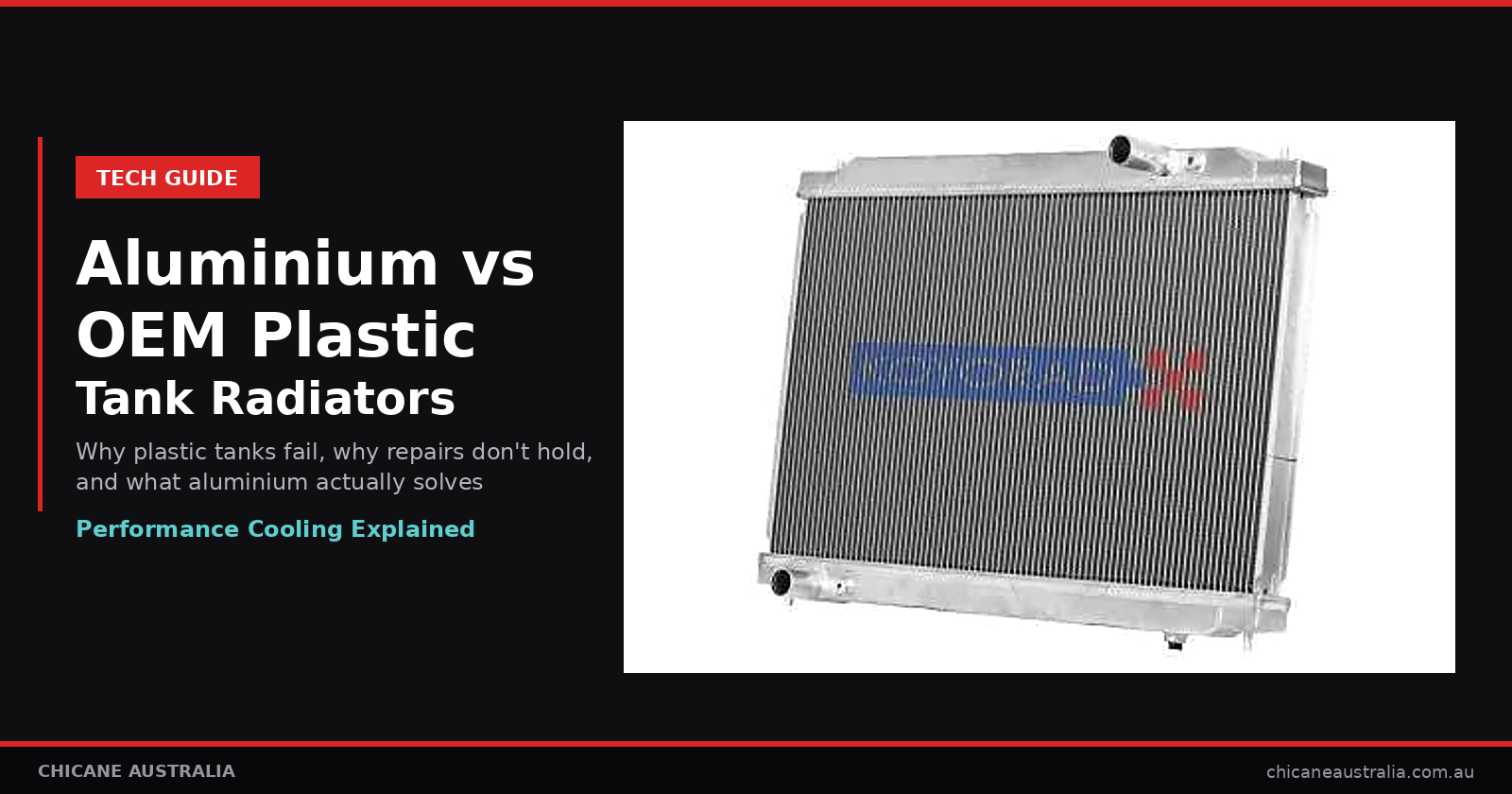


If you're shopping KOYORAD radiators for the first time, the product range can look overwhelming. R-Series, V-Core, Hyper V-Core, N-Flo, HH Series — five different ways KOYORAD's engineers approach the same problem of getting heat out of your engine. Picking the wrong one is rarely catastrophic, but it can leave you with a radiator that's heavier than it needed to be, doesn't fit the engine bay properly, or — surprisingly — cools the engine too much.
This guide breaks down what each KOYORAD series actually does, when each one is the right answer, and a couple of nuances about radiator selection most buyers' guides skip. The short version: thicker isn't always better, and KOYORAD's engineering team has been quietly rethinking that for the last decade.
The Five Series at a Glance
R-Series (53mm Core): KOYORAD's original heavy-capacity performance radiator. Thick aluminium core, prioritises coolant volume, ideal for older platforms where engine bay packaging allows the thicker radiator. Still produced for applications where it's the right answer, but being progressively replaced on newer platforms by the V-Core series.
V-Core Series (36mm Core): The modern KOYORAD reference point. Thinner core than the R-Series, but with higher fin and tube density to maintain or improve cooling capacity while reducing weight, improving airflow through the engine bay, and freeing up packaging space for other components. The series most modern installs go with.
Hyper V-Core Series (36mm Core, Hyper Fin/Tube Pitch): The premium V-Core variant. Same 36mm thickness as the standard V-Core, but with significantly increased fin and tube density to maximise surface area in the same physical footprint. Developed for modern vehicles with tight engine bays where N-Flo routing isn't possible.
HH Series (48mm Core, High-Density Fin): A dense, hand-assembled high-fin-density 48mm core for applications where the engine bay supports the thicker radiator. Found on platforms like the R32 Skyline GT-R where there's room to run a serious motorsport-grade radiator.
N-Flo Technology (Dual or Triple Pass Routing): Not a separate series, but a proprietary coolant routing technology applied to V-Core and HH cores where the factory inlet and outlet locations allow it. Uses internal partitions to force coolant through the radiator for longer, increasing heat transfer.
R-Series vs V-Core — Why KOYORAD Moved On From 53mm
This is the question every long-time KOYORAD customer asks: "I had an R-Series on my last car and it was great. Why is the new version a V-Core?"
KOYORAD's own engineering response to that question (from a 2018 customer service email) is genuinely illuminating: "The 53mm thick R-Series radiators are actually one of our oldest models and were developed when KOYORAD did not yet offer the 36mm cores for our performance radiators. As our core offerings have expanded and technology has improved, we can now get similar if not better results in smaller packages. Instead of prioritising coolant volume as the industry once did, we now take fin/tube density and overall size into consideration. With much less volume than our old 53mm core, you have less chance of the cooling system heat soaking."
The takeaway: bigger isn't better. A narrower radiator with denser fins and more tubes can match or beat a thicker, more voluminous radiator on cooling — while also offering better engine bay airflow, less weight, easier install, more room for other components (intercoolers, oil coolers, supporting hardware), and less risk of the cooling system itself becoming a thermal mass that holds heat.
For most modern applications, the V-Core or Hyper V-Core is now the right answer. The R-Series is still produced where it's genuinely needed — usually older platforms with deep engine bays and large factory cooling space — but if KOYORAD offers both an R-Series and a V-Core for your car, the V-Core is typically the newer, better-engineered choice.
V-Core vs Hyper V-Core — When the Extra Density Matters
Both share the same 36mm core thickness and the same all-aluminium construction. The difference is fin and tube pitch — the Hyper V-Core uses a significantly higher density to extract more cooling capacity from the same physical footprint.
That density costs something. Denser fins create more airflow resistance, which means the engine fan has to work harder to push air through the core. On most cars with healthy factory cooling fans this is a non-issue, but on older platforms with marginal fans or on very slow-moving traffic in extreme heat, the standard V-Core can occasionally have an edge in airflow over the Hyper V-Core.
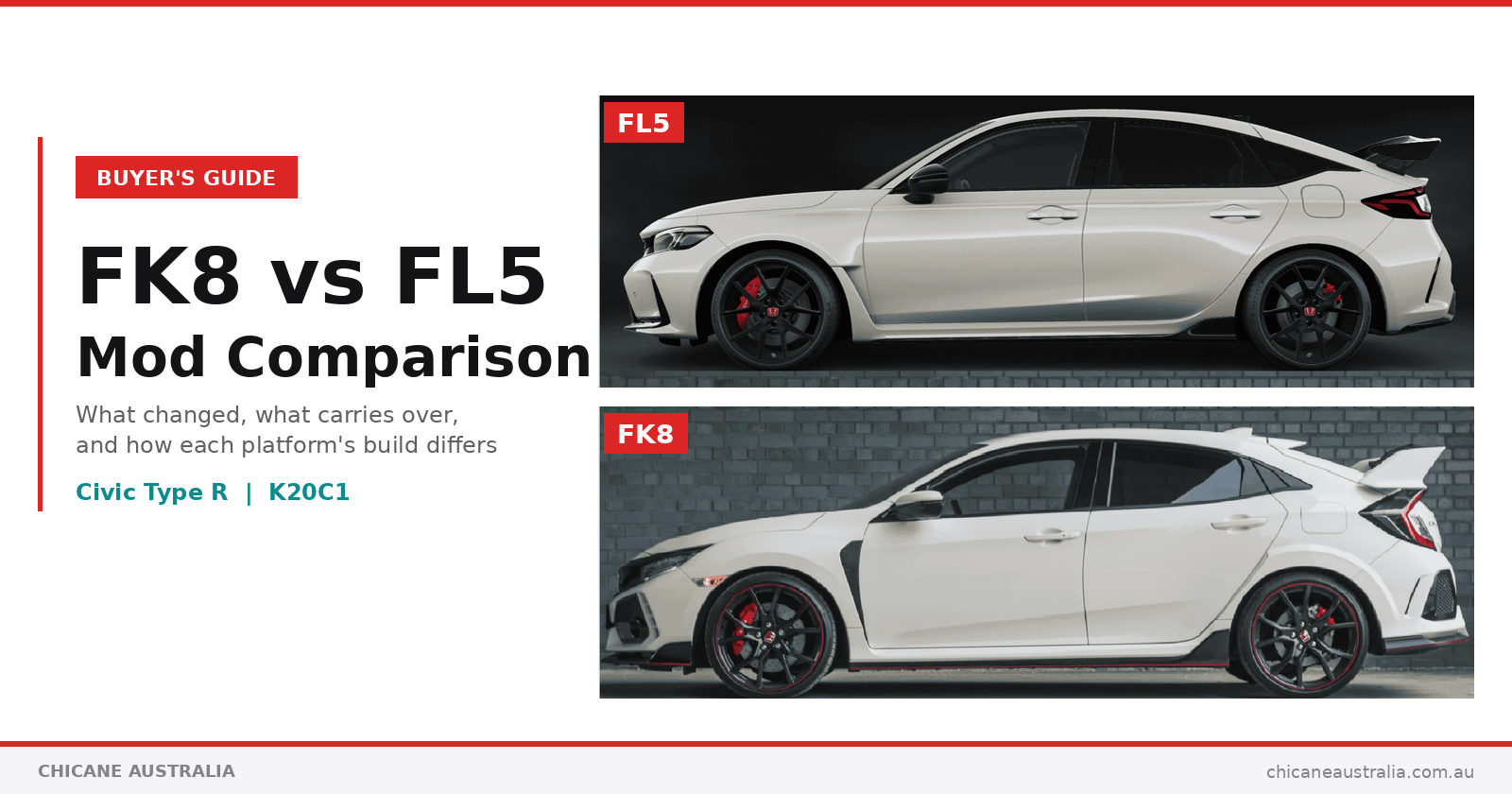
Where the Hyper V-Core wins is in modern, tightly-packaged engine bays. Cars like the WRX/STI, FK8/FL5 Civic Type R, and most current-generation performance vehicles have limited engine bay space and complex factory cooling routing that benefits from the maximum-surface-area approach. The Hyper V-Core was developed specifically for these vehicles — KOYORAD's own description calls it "the perfect solution where space savings and high performance is a must."
Practical guidance: if KOYORAD offers the Hyper V-Core for your application, it's almost always the right choice for modern cars (2008+). For older JDM platforms where airflow is less constrained, the standard V-Core may be the better-balanced option.
N-Flo Technology — The Trick KOYORAD Plays With Coolant Routing
This is where KOYORAD's engineering depth really shows. Standard radiators allow coolant to flow diagonally from inlet to outlet through the core. The coolant enters, passes through the core once, and exits — relatively short dwell time, relatively little heat transferred.
N-Flo radiators have aluminium partitions welded into the upper and lower end tanks that force the coolant to flow through the core in an N-shape — entering the radiator, flowing across one section, looping back through another, then exiting. The coolant stays in the core significantly longer, which means significantly more time for heat to transfer to the air passing through.
KOYORAD's published figures put the cooling efficiency gain at up to 50% over a comparable standard radiator. That's not a marketing exaggeration — physics actually supports it. More dwell time equals more heat transfer.
The catch: N-Flo only works if the factory radiator inlet and outlet are positioned in a way that allows the internal partition routing. Some cars (older WRX/STI, R32 Skyline, certain Hondas) have inlet/outlet positions that suit N-Flo perfectly. Other cars don't, which is exactly why KOYORAD developed the Hyper V-Core as a parallel solution for cars where N-Flo isn't possible.
If KOYORAD offers an N-Flo version for your car, take it. The cooling efficiency gain is the single biggest jump in the entire KOYORAD range and the only downside is a marginal weight increase from the extra aluminium partitions.
HH Series — When 48mm Makes Sense
The HH Series is KOYORAD's high-fin-density, thicker-core line. 48mm thick, hand-assembled, ultra-dense fin density. It's reserved for applications where the engine bay supports the thicker core and the cooling demands justify it — typically older motorsport-bred JDM platforms like the R32 Skyline GT-R.
On these older platforms with deep engine bays and serious cooling demands, the HH Series is unambiguously the best radiator KOYORAD makes. It's not the right answer for every car, but where it's offered, it's worth the premium.
The Over-Cooling Problem Nobody Talks About
Here's a counter-intuitive consideration that catches a lot of buyers out: you can over-cool an engine.
From KOYORAD's own technical guidance: "An engine that is over cooled or has difficulty reaching its proper operating temperature tends to run at a rich state and not within the vehicle manufacturer's recommended conditions."
Modern engines are designed to operate at a specific coolant temperature — typically around 90-95°C. The ECU expects to see coolant temperatures in that range and adjusts fuel trims, ignition timing, and emissions equipment accordingly. If you install a radiator that's drastically oversized for the engine's heat output, the engine never gets up to proper operating temperature, and you end up running rich (worse fuel economy, deposits in the combustion chamber, premature oil dilution) and operating outside the manufacturer's design envelope.
This is why KOYORAD's modern philosophy is "right-sized, dense, efficient" rather than "biggest possible." The V-Core and Hyper V-Core series exist precisely because the older "bigger is better" approach has real downsides on modern engines.
Practical takeaway: don't pick a radiator based on physical size or coolant volume alone. Pick based on the engine's actual cooling demand and the driving environment. For a stock-tune car driven mostly on the street, a Hyper V-Core with N-Flo will typically be over-engineered. For a tuned street/track car in a hot climate, it's perfect. For a dedicated track car or high-power build, the HH Series or thicker-core options earn their keep.
What All KOYORAD Series Share
Regardless of which series you choose, every KOYORAD performance radiator includes the same fundamentals:
- Japanese-engineered at KOYORAD's head office in Nagoya, Japan, and built in KOYORAD's wholly-owned ISO 9001 certified facility in Indonesia under Japanese engineering oversight — not subcontracted
- Hand TIG-welded end tanks — not machine welded, not seam-only welded, properly hand-welded by KOYORAD technicians
- Nocolok-brazed aluminium cores for maximum thermal conductivity and joint integrity
- Factory-position fitment retaining stock fan shrouds, fan mounts, hose locations and (where applicable) sensor bungs
- No engine modifications required for direct-fit installation
How to Pick the Right Series for Your Car — Quick Decision Guide
Modern car (2008+) with tight engine bay, daily driver or street/track: Hyper V-Core if KOYORAD offers it. Standard V-Core if not.
Modern car (2008+) where N-Flo is available: Take the N-Flo version. The cooling efficiency gain is the biggest single jump in the KOYORAD range.
Older JDM platform (1990s-2000s) with deep engine bay and serious cooling demands: HH Series if offered, otherwise R-Series.
Older JDM platform with moderate cooling demands and a stock-tune build: V-Core or R-Series, whichever KOYORAD currently produces for your application.
Dedicated motorsport / circuit car: The thickest core KOYORAD offers for your application, with N-Flo if available. Track use justifies maximum cooling capacity even at the cost of some on-road balance.
If you're still not sure after working through that list, get in touch — we know which KOYORAD series suits which application and we'd rather spec the right radiator once than the wrong one twice.
Shop KOYORAD by Vehicle
Browse the full KOYORAD collection at Chicane Australia or jump straight to your platform:
KOYORAD for Nissan Skyline R32 / R33 / R34
KOYORAD for Toyota Supra A80 / A90
KOYORAD for Subaru WRX / STI
KOYORAD for Toyota 86 / Subaru BRZ / GR86
KOYORAD for Toyota GR Yaris (G16E-GTS)
KOYORAD for Mazda RX-7 FD / RX-8
KOYORAD for Nissan Silvia / 180SX S13 / S14 / S15
KOYORAD for Honda S2000
KOYORAD for Honda Civic Type R
Not sure which series suits your build? Contact us or email sales@chicaneaustralia.com.au — we'll spec the right KOYORAD for your power target, climate, and driving style.