

The factory radiator on your car is a service item with a use-by date. Most car owners don't realise it. Performance shops do, and so do every car manufacturer's engineers — which is exactly why plastic-tank radiators are designed the way they are. They're cheap to manufacture, light enough to help fuel economy figures, and they last just long enough to outlive most warranty periods. After that, they crack, leak, and fail.
This isn't a scare tactic — it's well-documented engineering reality. Australian radiator specialist Natrad puts the average plastic-tank lifespan at 8 to 10 years. Trade radiator shops in the US quote 7-10 years or around 100,000 miles (160,000km). Either way, if your car is past the decade mark and still running its factory radiator, you're already on borrowed time.
Here's why plastic tanks fail, why repairs rarely hold, and why an all-aluminium replacement is a permanent fix rather than a kick-the-can-down-the-road repair.
What "Plastic Tank" Actually Means
First, a quick technical correction. The plastic in a modern factory radiator isn't generic plastic — it's glass-reinforced nylon composite, typically a polyamide matrix with chopped fibreglass reinforcement (commonly called PA66-GF30 or similar). It's genuinely strong material when new, heat-resistant to around 130°C continuous service, lightweight, and cheap to injection-mould.
The aluminium part is the core — the network of thin-walled tubes and fins that actually does the heat transfer. The plastic forms the upper and lower end tanks that hold the coolant at each end of the core. A rubber gasket seals the joint between the plastic tank and the aluminium core, held in place by crimped aluminium tabs.
It's a clever design and it works brilliantly for the first decade. The problem is what happens after that.
Why Plastic Tanks Fail — The Thermal Cycling Problem
Every time you start your engine, the coolant heats from ambient to roughly 95°C operating temperature. Every time you turn off the engine, it cools back down. The plastic tank expands and contracts with each cycle. Glass-reinforced nylon expands and contracts at a different rate than the aluminium core it's clamped to, so the rubber gasket and the crimped joint have to absorb the differential movement.
Over thousands of cycles, several things happen:
1. The plastic embrittles. Prolonged exposure to heat, coolant chemistry (especially the corrosion inhibitors and pH-stabilising additives in modern long-life coolants), and UV from the under-bonnet environment causes the polymer chains to break down. The glass fibre reinforcement doesn't degrade, but the nylon matrix holding it together does. Microscopic cracks start forming, particularly in the highest-stress areas.
2. The highest-stress areas are predictable. Plastic tanks consistently fail at the same locations across virtually every brand and model: the inlet tank (top tank, where hot coolant enters from the engine), specifically at or near the radiator hose outlet, and at the gasket seam where the tank meets the aluminium core. The reason is simple — these areas see the highest thermal differential and the highest mechanical stress concentration. The outlet tank rarely fails because it sees cooler coolant.
3. Once a crack starts, it spreads. The pressurised cooling system (typically 1.0–1.4 Bar) constantly pushes against the weakened plastic, and every heat cycle expands the crack a tiny amount. What starts as a barely-visible hairline becomes a weeping seep over months, then a steady drip, then a sudden failure under thermal load.
This is why "I overheated and lost coolant fast" is so often the first symptom of plastic-tank failure — the radiator has been cracking quietly for weeks, but the failure point arrives when the engine is working hardest.
Why Repairs Don't Hold
Plastic radiator tanks can technically be repaired — there are plastic welders who specialise in it, and various epoxy and patch kits exist. The trade reality is that these repairs are temporary at best.
The fundamental issue: the cracked area didn't fail because of a one-off impact or defect. It failed because the surrounding plastic has degraded to the point where it can no longer handle the thermal cycling stress. Even if you successfully bond a patch over the crack, the plastic next to your patch is just as brittle as the plastic that just failed. Another crack will form within months, typically next to the repair.
A US trade radiator shop put it bluntly in industry literature: "I have never seen any other method work for more than a few hundred miles or a week or two… the tank itself is degraded to the point of causing the crack in the first place so you're trying to repair something that is beyond its life span."
The honest options when a plastic tank cracks are: replace the tank (some radiators allow this, though many don't), replace the whole radiator with another plastic-tank OEM-spec unit (giving you another 8-10 years if you're lucky), or upgrade to an all-aluminium radiator that doesn't have the failure mode at all.
Why Aluminium Solves the Problem
An all-aluminium radiator removes the failure mechanism entirely. Aluminium doesn't embrittle from heat cycling. It doesn't degrade from coolant chemistry. It doesn't have a gasket-and-crimp seam that needs to flex differentially. The end tanks are TIG-welded directly to the aluminium core, creating a single-material structure that expands and contracts as one piece.
Provided the cooling system is properly maintained (correct coolant, regular flushes, no severe corrosion), an all-aluminium radiator has no defined service life. Vintage all-aluminium radiators from the 1990s are still in service today on cars that have been driven hundreds of thousands of kilometres. Even motorsport radiators that see harder use than any street car retire after seasons of abuse, not because of inherent material failure.
The trade-off historically was cost — all-aluminium radiators were more expensive to manufacture. Modern production methods (Nocolok flux brazing, precision aluminium extrusion, TIG-welded billet end tanks) have closed that gap significantly, and a quality all-aluminium replacement is now genuinely competitive with replacing a plastic-tank OEM unit.
The Performance Side — More Than Just Durability
An all-aluminium radiator isn't just a durability upgrade. The same engineering approach that makes the tanks more durable also delivers measurable performance gains.
Greater core capacity. Most performance aluminium radiators use thicker cores (typically 36mm or more, compared to OEM cores around 16-22mm) and denser fin/tube arrangements. The result is significantly more coolant volume and significantly more heat transfer surface area in the same physical envelope. Cooling capacity gains of 30-50% over OEM are typical.
Better thermal stability. The larger thermal mass of the aluminium structure and increased coolant volume means the cooling system handles spikes (sustained hill climbs, hot ambient days, track sessions) without the temperature creep that factory radiators show when their headroom runs out.
Improved coolant flow. Performance radiators often use larger inlet/outlet diameters, better internal flow paths, and (in some cases) dual-pass routing that increases coolant dwell time in the core. The cumulative effect is more heat extracted per litre of coolant flow.
For a stock-tune daily-driven car, the durability gain alone justifies the upgrade once your OEM radiator is past the warranty zone. For a tuned car, an upgraded car, or a car driven hard, the performance gain is the additional reason to do it.
When Should You Upgrade?
Three scenarios where the maths comfortably works:
1. Your factory radiator is approaching or past 10 years old. You're in the failure window. Replacing it with another plastic-tank OEM unit means you're committing to doing this again in 8-10 years. An all-aluminium upgrade is a one-time investment.
2. You've added power, supporting mods, or changed your driving. Factory cooling is sized for factory power. Add a turbo upgrade, a tune, more boost, or move from commuting to occasional track work — and the factory radiator runs out of thermal headroom. Performance aluminium radiators typically restore 30-50% of cooling capacity.
3. You drive in genuinely demanding conditions. Australian summers, towing, sustained hill climbs, hot stop-start traffic in 40°C heat — these are all conditions where factory cooling is at its margins. If your temp gauge climbs above its normal position regularly, the cooling system is telling you something.
The honest counter-argument: if your car is a low-kilometre daily driver, well under 10 years old, never tuned, never tracked, and lives in temperate conditions — the OEM plastic-tank radiator will probably outlast your ownership of the car. Don't fix what isn't broken. This blog is for the other category of owner.
Don't Get Caught Out by the Wrong Aluminium Radiator
One caveat worth flagging. "All-aluminium" is sometimes used loosely. Some budget radiators marketed as aluminium use thin-gauge aluminium tanks that are stamped and welded rather than billet-machined, often with hand-welded seams of variable quality. These can fail at the weld seam in much the same way plastic tanks fail at the gasket — just for different reasons.
What to look for in a quality all-aluminium performance radiator:
- Hand or precision TIG-welded end tanks — not robot-welded, not seam-welded, not crimped. Hand TIG-welding is the JDM and motorsport benchmark
- Nocolok-brazed cores — a controlled-atmosphere brazing process that produces clean, strong, flux-residue-free joints between fins and tubes
- Billet or precision-machined filler neck and fittings — not stamped, not pressed
- Manufacturer reputation and warranty — established brands with motorsport pedigree
- Factory-position fitment — retains stock fan shrouds, mounts and hose locations so installation doesn't require fabrication
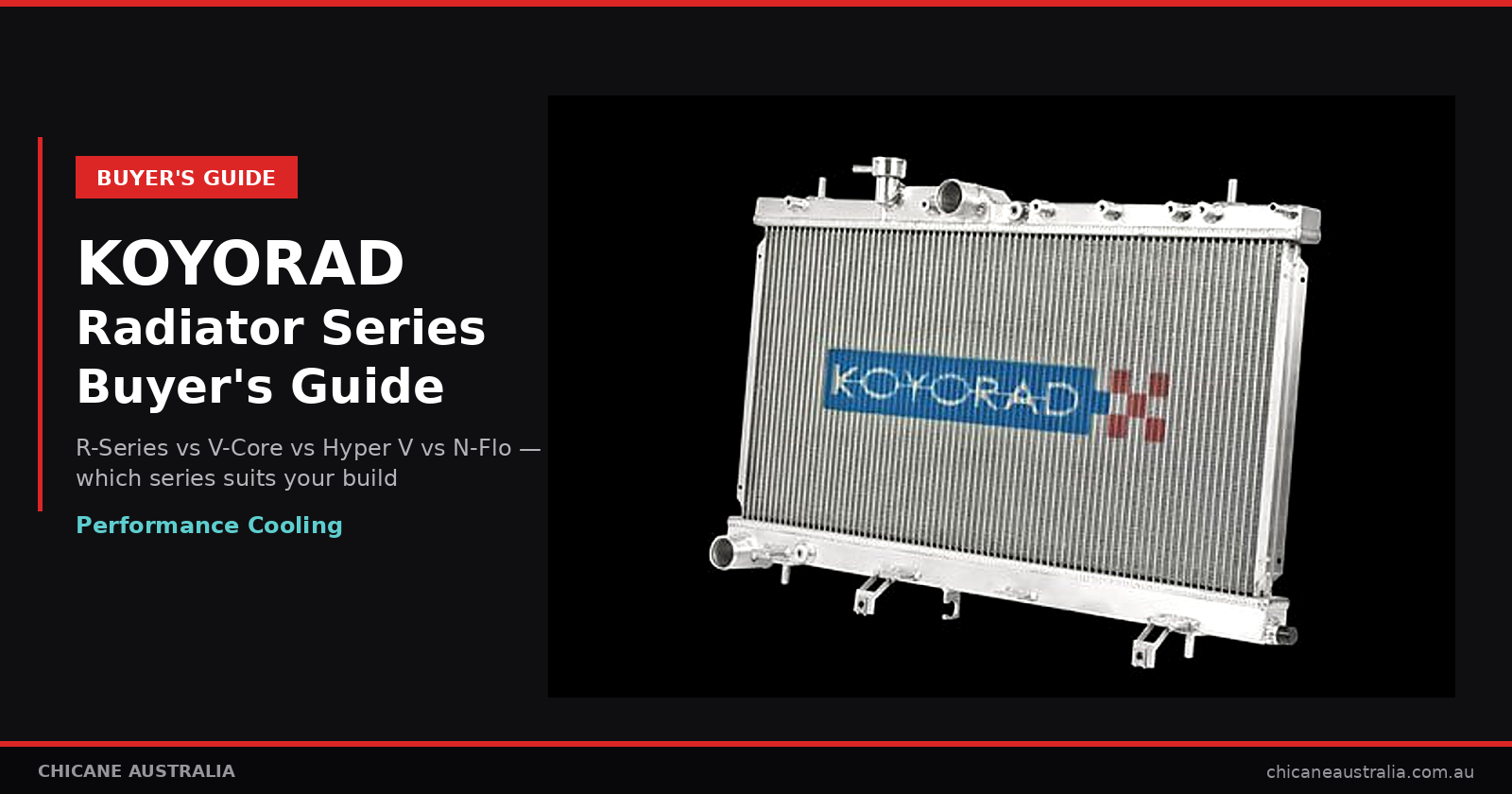
Brands that consistently hit all of these criteria include KOYORAD, Mishimoto and CSF. Each has different strengths — see our KOYORAD vs Mishimoto vs CSF comparison for the detailed breakdown.
The Bottom Line
Factory plastic-tank radiators are a service item with a defined lifespan, not a permanent component. The engineering reasons for their failure are well-understood, predictable, and unavoidable. Repairs don't hold long-term because the surrounding material is already degraded.
For an aging car, a tuned car, a tracked car, or a daily driver in demanding conditions, an all-aluminium performance radiator is a permanent solution to a problem the factory radiator can't avoid. The same upgrade also delivers meaningful cooling capacity gains that benefit the engine in every condition.
If your factory radiator is past 8 years old or you're modifying the car, it's worth doing once and doing right.
Shop Performance Aluminium Radiators
Browse the full KOYORAD aluminium radiator range at Chicane Australia, with applications for most JDM and modern performance platforms. Need help picking the right radiator for your car? Contact us or email sales@chicaneaustralia.com.au — we know cooling and we'll spec the right radiator for your build and driving style.