

You've fitted better pads. You've flushed the fluid. You've maybe even gone to a slotted disc. But a few laps in — or halfway down your favourite set of corners — the pedal still goes long and the wheel still shimmies on the next stop. That's usually when someone in the paddock or on the forum mentions 2-piece rotors.
The obvious question: are they a genuine upgrade, or motorsport theatre? Short answer — for the right car and the right driver, 2-piece rotors are one of the most meaningful brake upgrades you can make short of a full big brake kit. Here's why, and where Paragon Performance fits into the picture.
What Is a 2-Piece Rotor?
A conventional rotor — the kind fitted to almost every car from the factory — is a single casting. The friction surface, the vanes, the mounting hat — all one piece of cast iron. It works, it's cheap, and it lasts a long time under normal driving.
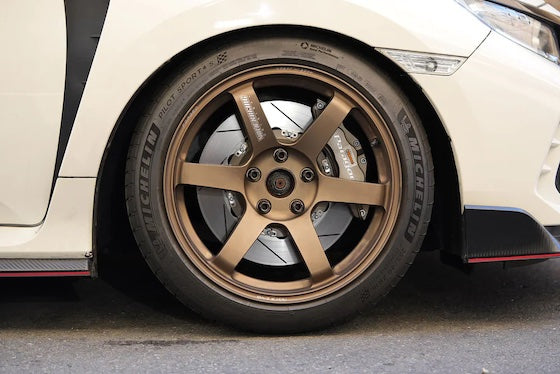
A 2-piece rotor splits that casting into two distinct parts:
- The rotor ring — the cast iron friction surface that the pads actually contact.
- The rotor hat — a machined aluminium centre section that bolts to the wheel hub.
The two are joined by a set of small stainless steel fasteners called bobbins, which can either be rigidly bolted (a non-floating design) or allowed a small amount of radial movement (a fully-floating design). That small distinction turns out to matter a lot once the rotors get hot, and we'll come back to it.
The Real-World Benefits of a 2-Piece Rotor
1. Less unsprung weight
An aluminium hat is dramatically lighter than the equivalent mass of cast iron. On Paragon's 300x25.4mm rotor for the Honda S2000, each rotor weighs around 6.05kg — roughly half a kilo lighter than OEM, per corner. On the 348x36mm rotor for the Toyota GR Supra Mk5 and BMW Z4 G29, the saving climbs to around 1.8kg per rotor.
Unsprung weight matters more than weight anywhere else on the car. It's the mass your suspension has to control — accelerating it vertically over every bump, loading your dampers, and forcing your springs to compromise between grip and ride. Dropping even a kilo per corner is felt through the steering, felt in suspension response over mid-corner bumps, and felt in how quickly the wheel follows the road surface after a camber change.
2. Thermal isolation from the hub
Cast iron conducts heat. Aluminium conducts it faster — but it also radiates it faster, and it's not in direct contact with the part of the assembly that matters: the friction ring. An aluminium hat acts as a thermal barrier between the glowing rotor ring and the wheel bearing, hub, and CV joint behind it.
On cars that see repeated hard braking, this is meaningful. Roasted wheel bearings and heat-soaked hubs are a real issue on track-driven street cars, and a 2-piece rotor dramatically reduces the thermal load on those components.
3. Controlled thermal expansion — fewer warped rotors
This is where the floating part of "fully-floating 2-piece" earns its keep. Cast iron expands when it gets hot. A 1-piece rotor can't go anywhere when that happens — it's rigidly bolted at its centre — so the stress translates into coning, judder, and over time, cracking.
A floating 2-piece rotor lets the ring expand radially against the bobbins without transferring stress to the hat. The ring grows, the hat stays square, and the braking surface stays flat. It's the single biggest reason 2-piece rotors resist the classic "warped rotor" vibration that shows up after a hard track session.
4. Better cooling under sustained load
Paragon's 2-piece designs use directional ventilation vanes — curved vanes that actively pump air through the rotor as the wheel rotates, rather than the straight vanes used on most factory discs. Paragon rates this as up to 30% cooler operation vs OEM, which translates directly to less fade at the end of a session and longer pad life.
Vane count varies by application — the Jeep Grand Cherokee SRT 380x34mm and Honda Civic Type R FK8/FL5 front rotors use a 48- or 72-vane pattern depending on fitment — but the principle is consistent across the range.
5. Rebuildable
When a 1-piece rotor wears past minimum thickness, it's binned. With a 2-piece rotor, the hat doesn't wear out — only the friction ring does. Paragon sells replacement rotor rings separately, which means the second set of rotors is substantially cheaper than the first. For a car that sees regular track time, that adds up quickly.
When a 2-Piece Upgrade Actually Makes Sense
2-piece rotors are a real investment, so the honest answer is: it depends on how you use the car.
Worth the money if:
- You track the car, run hillclimbs, or do track days more than a couple of times a year.
- You've already upgraded pads and fluid and are still out-braking the factory setup.
- You experience pedal pulsation, judder, or vibration after sustained hard use.
- You want serious brake upgrades without jumping straight to a full big brake kit.
- You're running a Brembo-equipped factory caliper (like the FK8/FL5 Civic Type R) and want to keep OEM ABS calibration and brake bias.
Probably overkill if:
- You daily the car in traffic and never push the brakes past 60%.
- You've never had pad fade or rotor vibration as an actual problem.
- You're planning a full BBK with bigger calipers and bigger rotors in the near future.
Floating vs Non-Floating 2-Piece — Which Do You Need?
Paragon's front rotors are fully-floating, because the front brakes take the brunt of the heat and benefit most from controlled thermal expansion. The rear rotors — for example, the 305x11mm / 350x11mm rear rotor pair for the Civic Type R FK8/FL5 — are non-floating.
That's not a cost-cutting measure. Rear rotors see dramatically less heat than fronts, so the floating feature's main benefit (resisting thermal distortion) doesn't meaningfully apply. You still get the aluminium-hat weight savings and the thermal isolation benefit. It's the right engineering call.
Why Paragon Specifically?
There are plenty of 2-piece rotors on the market. A few details put Paragon Performance toward the front of the pack for serious enthusiasts:
- CM-250 high-carbon alloy cast iron — formulated specifically for high bite, high-temperature durability, and resistance to thermal cracking.
- CBN-machined braking surfaces — cubic boron nitride surface finishing produces an exceptionally flat, true friction surface that beds pads quickly and consistently.
- 6061-T6 aerospace-grade aluminium hats — hard anodised to MIL-A-8625 Type III spec, which means they'll handle corrosion and heat cycling without discolouration. Clear-anodised options are available for track-focused cars that want to stay dark under extreme heat.
- Heat-treated and balanced — each rotor ring is stress-relieved to prevent deformation, with lateral run-out held under 0.03mm and weight variation within 2 grams per rotor. That's the kind of tolerance you'd expect from a motorsport supplier.
- Direct OEM bolt-on — Paragon's application-specific designs work with factory calipers, OEM ABS, and factory brake bias. No pad changes required, no proportioning valve drama.
- Slotted as standard — every Paragon 2-piece rotor has a slotted face for consistent pad contact, better wet-weather braking, and improved gas venting during hard stops.
Fitments Available at Chicane Australia
The Paragon range at Chicane covers the most commonly upgraded chassis for track-focused enthusiasts across both JDM and Euro platforms.
JDM & Performance Fitments
- Honda Civic Type R FK8 / FL5 — 350x32mm front and 350x11mm rear. Specifically addresses the grooving issue on 2017–2019 FK8 OEM rotors.
- Honda S2000 AP1 / AP2 — 300x25.4mm front. Direct OEM bolt-on.
- Toyota GR Supra Mk5 / BMW Z4 G29 — 348x36mm front. ~1.8kg per rotor weight saving vs OEM.
- Holden Commodore VE / VF SS-V Redline — 355x32mm front.
- HSV Clubsport VF / VF R8 — 367x32mm front.
- Jeep Grand Cherokee SRT — 380x34mm front. 72-vane directional cooling.
European Fitments
- BMW M2 G87 / M3 G80 / M4 G82 / G83 — 380x36mm front and 370x24mm rear. 72-vane directional cooling on the fronts.
- BMW M2 F87 / M3 F80 / M4 F82 / F83 (F-chassis) — front and rear options available in blue-caliper and gold/red/silver-caliper variants.
- Audi RS3 Sedan 8V / 8V.5 — 370x34mm front. Note: RS3 Sportback and TT RS 8S use different fitments.
- Audi RS4 B8 / 8K (2012–2015) — 365x34mm front.
- Porsche 981 / 718 Cayman GT4 / 991 Turbo & Turbo S — 380x34mm front, 380x30mm rear, plus 410x36.5mm iron conversion for GT4 platforms.
- Renault Megane 2 RS 225 — 330x28mm front.
- Lotus Evora / Evora S S1 — 362x32mm front.
- Audi TT RS 8J, Cupra Leon VZx, Cupra Formentor VZx — 370x32mm front application, available via the full Paragon collection.
If your car isn't listed, get in touch — the range is broader than what's on the site, and custom fitments can be sourced through Paragon directly.
Pairing Paragon Rotors With the Right Pad
A 2-piece rotor is only one half of the equation — the pad compound you run against it determines how the whole system behaves under heat. Most Paragon customers pair these rotors with DIXCEL pads, which cover everything from quiet low-dust street compounds (EC, M Type) through to track-focused pads (ES, Z Type) and dedicated motorsport compounds (RA, RE, Specom-β).
If you're unsure which compound suits how you drive, the DIXCEL Compound Guide walks through each pad's operating window, friction curve, and typical use case. For convenience, Chicane also offers pre-matched Paragon × DIXCEL bundles for common platforms including the BMW M2/M3/M4, Civic Type R FK8/FL5, VW Golf R Mk7–Mk8, and Audi S3 8V.
When to Step Up to a Full Big Brake Kit
If a 2-piece rotor alone isn't enough — because you're running more power, bigger wheels, or higher sustained speeds — Paragon also builds complete big brake kits using their PA015 or PA035 6-piston calipers paired with oversized 2-piece floating rotors. Common fitments include the Civic Type R FK8 / FL5, VW Golf / GTI / Golf R Mk5–Mk8, and the Porsche 718 Boxster / Cayman / Spyder.
The full range of Paragon, AP Racing, Alcon, and Brembo Pista big brake kits lives in the Big Brake Kits collection.
Frequently Asked Questions
Are 2-piece rotors worth it for a street-driven car?
If the car is street-only and never sees sustained hard braking, probably not. The main benefits — controlled thermal expansion, heat isolation from the hub, and fade resistance — mostly show up above 400°C rotor temperatures, which you won't hit in normal road driving. That said, the unsprung weight saving is noticeable on any car and some enthusiasts value it purely on that basis.
Will Paragon 2-piece rotors fit my OEM calipers?
Yes. Every Paragon 2-piece rotor in the Chicane range is a direct OEM bolt-on designed to work with the factory caliper, OEM ABS system, and factory brake bias. You can also keep your current pads, as long as they're the correct pad shape for your car.
How much weight do Paragon 2-piece rotors save vs OEM?
It varies by fitment, but expect roughly 0.5kg to 1.8kg per rotor depending on diameter. The GR Supra / Z4 348x36mm saves around 1.8kg per corner vs OEM; smaller rotors like the S2000 300x25.4mm save closer to 0.5kg. Over both axles, the total unsprung weight reduction is meaningful.
Can I replace just the rotor ring when it wears out?
Yes — that's one of the main cost advantages of a 2-piece rotor. When the friction ring reaches minimum thickness, the aluminium hat, bobbins, and hardware can all be reused. Paragon sells replacement rotor rings separately for common sizes.
What's the difference between floating and non-floating 2-piece rotors?
A floating 2-piece rotor allows the cast iron ring to expand radially against the bobbins without transferring thermal stress to the hat. A non-floating 2-piece rigidly bolts the ring to the hat. Floating designs are preferred for front rotors where heat is highest; non-floating is common for rear rotors where the thermal loads are much lower.
Are 2-piece rotors legal for road use in Australia?
Replacing OEM rotors with 2-piece rotors of equivalent size and specification is generally treated the same as any brake rotor replacement under ADR 31 — provided the rotor maintains the original diameter and the braking system remains unmodified in its effectiveness. Paragon's direct-fit rotors are designed around OEM dimensions. If you're unsure about your specific state's engineering requirements, check with your local transport authority before fitment.
The Bottom Line
A 2-piece rotor isn't about raw stopping power — a well-bedded pad on a factory disc can lock up just as hard from 60 to 0. What they're about is consistency: the ability to make that same stop, from the same speed, at the same pedal effort, ten times in a row without fade, judder, or thermal distortion.
For an enthusiast who actually uses their car, that's a real upgrade. And Paragon's build quality — CM-250 iron, CBN machining, MIL-spec anodising, sub-2-gram balance — puts them in a genuinely high tier without the price tag of a full motorsport setup.
If you're weighing it up for a specific build, the Chicane team can help you figure out whether Paragon 2-piece rotors make sense for your car and how they'll pair with your current pad and fluid setup. Browse the Paragon collection here, or drop us a message if you want a recommendation for your platform.