

What Is Camber and Why Does It Matter?
Your car's suspension does more than smooth out bumps — it determines how your tyres contact the road, how the car responds to steering input, and how much grip you have in a corner. One of the most important elements of suspension tuning is camber: the tilt of your wheels relative to vertical when viewed from the front or rear. Getting camber right is the difference between a car that pushes wide through every corner and one that bites into the apex with confidence.
This guide covers what camber is, how it affects handling and tyre wear, what settings suit street versus track driving, and specific alignment recommendations for popular Australian performance platforms including the Toyota GR86, Subaru WRX/STI, Honda Civic Type R, and Mitsubishi Evo.
Camber Types — Negative, Neutral, and Positive
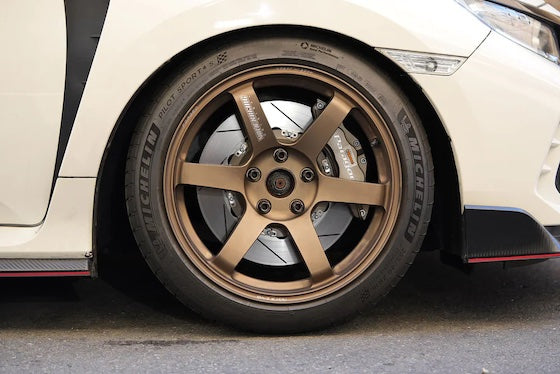
Negative camber is when the top of the wheel tilts inward toward the car. This is the most common performance setting because it keeps the tyre flat against the road surface under body roll during cornering. When you turn hard into a corner, the car's weight shifts and the suspension compresses — negative camber compensates for this movement, maintaining a larger contact patch on the outside tyres when you need grip most.
Neutral camber (zero) is when the wheel sits perfectly vertical. This gives the largest contact patch in a straight line, which is ideal for even tyre wear and braking performance. Factory alignment specs on most road cars sit near zero camber for this reason — it prioritises safety, comfort, and tyre longevity over cornering performance.
Positive camber is when the top of the wheel tilts outward. This is almost never used in performance applications. You might see it on some off-road vehicles or agricultural equipment, but for any car that corners, positive camber reduces grip and is generally undesirable.
Performance Benefits of Negative Camber
Increased lateral grip in corners. As the car rolls under cornering load, negative camber keeps the tyre flat against the road. Without it, the tyre rolls onto its outer edge and you lose contact area — which means less grip and earlier understeer.
Sharper turn-in response. Even a modest increase in negative camber — from factory zero to -1.5° — makes a noticeable difference in how quickly the car responds to steering input. The tyre is already angled into the corner before the car even starts to roll.
Better tyre temperature management on track. If you're seeing heavy wear on the outside edge of your front tyres after a track session, you almost certainly need more negative camber. Even tread wear across the full tyre width is the goal — and a tyre pyrometer is the best tool for confirming this.
Trade-Offs of Aggressive Camber
More camber is not always better. Aggressive negative camber comes with trade-offs that matter for street-driven cars:
Reduced straight-line braking performance. In a straight line, a heavily cambered tyre has a smaller contact patch than a vertical one. This means less grip under hard braking when the car is not turning.
Uneven tyre wear. The more negative camber you run, the faster the inner edge of the tyre wears. For a dedicated track car this is acceptable — for a daily driver, it means replacing tyres more frequently.
Tramlining and instability on rough roads. Heavily cambered tyres are more sensitive to road surface imperfections. The car may feel like it's wandering or being pulled toward grooves and ruts in the road.
If you daily drive your car, milder settings (-1.0° to -2.0° front) give you noticeably better cornering without destroying your tyres or making the car unpleasant on bumpy Australian roads.
Camber and Suspension Stiffness — How They Interact
Camber and suspension stiffness are directly linked. A stiffer suspension (higher spring rates, stiffer anti-roll bars) reduces body roll, which means the tyres stay closer to their static camber angle through a corner. This means you can run less static negative camber on a stiff setup and still maintain a good contact patch under cornering load.
Conversely, a softer suspension (standard springs, comfort-focused dampers) allows more body roll, which pushes the tyre onto its outer edge. Softer setups need more static negative camber to compensate.
This is why fitting quality coilovers like AST or Moton often changes the optimal alignment — the stiffer setup controls body roll better, so the camber requirements shift. If you've recently changed your suspension, get a fresh alignment that accounts for the new ride height and roll characteristics.
Camber Settings by Drivetrain
Front-Wheel Drive (FWD)
FWD cars like the Honda Civic Type R put all their power and steering through the front tyres. This makes front camber critical — you need enough negative camber to maximise front grip without inducing excessive tyre wear. Rear camber is less aggressive because the rear tyres primarily provide stability. Typical FWD track settings: -3.0° to -3.5° front, -2.0° to -2.5° rear.
Rear-Wheel Drive (RWD)
RWD cars like the Toyota GR86 separate the duties — front tyres steer, rear tyres deliver power. Front camber improves turn-in and steering response, while rear camber balances traction on corner exit. Too much rear camber reduces straight-line acceleration grip. Typical RWD track settings: -3.0° to -4.0° front, -2.0° to -2.5° rear.
All-Wheel Drive (AWD)
AWD cars like the Subaru WRX/STI and Mitsubishi Evo need balanced camber front and rear because all four tyres handle both cornering and power delivery. Typical AWD track settings: -2.5° to -3.5° front, -2.0° to -2.5° rear.
Vehicle-Specific Camber Settings
Toyota GR86 / Subaru BRZ
The GR86 and BRZ use MacPherson struts at the front and double-wishbone at the rear. The front strut design has limited camber gain, so the car benefits significantly from additional static negative camber. Factory camber is near zero, which is why many GR86 owners report heavy wear on the outside of front tyres after track use.
Street: -1.5° to -2.5° front, factory rear (-1.5° to -1.7°). Zero front toe.
Track day / HPDE: -3.0° front, -2.0° rear. Requires camber plates or adjustable strut tops.
Dedicated track: -3.5° to -5.0° front, -2.5° to -3.5° rear. Requires camber plates plus adjustable rear lower control arms.
Hardware needed: Camber plates (AST or Moton include adjustable top mounts with their coilovers), adjustable rear lower control arms from Hardrace, and a proper four-wheel alignment.
Subaru WRX / STI
The WRX and STI use MacPherson struts at the front. Similar to the GR86, camber gain is limited and additional static camber is needed for track use. The AWD system loads the front brakes heavily under trail braking, so front camber is important for both turn-in grip and front tyre longevity.
Street: -1.5° to -2.0° front, -1.5° rear. Zero toe front, slight toe-in rear.
Track day: -2.5° to -3.0° front, -2.0° rear.
Dedicated track / time attack: -3.0° to -3.5° front, -2.0° to -2.5° rear.
Hardware needed: Camber plates or adjustable strut top mounts (standard with AST and Moton coilovers), Hardrace adjustable arms for rear camber adjustment.
Honda Civic Type R (FK8 / FL5)
The Civic Type R is a FWD car that relies entirely on the front tyres for both steering and power delivery. Front camber is critical. On the FK8 and FL5, pulling the factory camber pins gives approximately -1.8° — but for serious track use, you need camber ball joints or coilovers with adjustable strut tops to reach -3.0° or beyond.
Street: -1.5° to -2.0° front (camber pins pulled), -1.5° rear. Zero toe front, slight toe-in rear.
Track day: -2.5° to -3.0° front, -2.0° to -2.5° rear. Requires camber ball joints or adjustable top mounts.
Dedicated track / time attack: -3.2° to -3.8° front, -2.5° rear. Coilovers with adjustable strut tops plus Hardrace camber and toe arms for the rear.
Mitsubishi Lancer Evolution
The Evo uses MacPherson struts at the front and multi-link at the rear. The AWD system and aggressive driving style of most Evo owners means front camber needs to be strong — trail braking into corners loads the front heavily. The multi-link rear gives better camber gain than a MacPherson setup, so rear camber requirements are slightly less aggressive.
Street: -1.5° to -2.0° front, -1.5° rear.
Track day: -2.5° to -3.0° front, -2.0° rear.
Dedicated track / time attack: -3.0° to -4.0° front, -2.0° to -2.5° rear.
Camber Gain and Suspension Geometry
Not all suspension types behave the same under body roll. A well-designed suspension dynamically adjusts camber as the car rolls into a corner — this is called camber gain.
MacPherson strut suspensions (GR86 front, WRX/STI front, Civic Type R front) have relatively poor camber gain. The geometry means the wheel actually loses negative camber as the suspension compresses — exactly when you need it most. This is why MacPherson strut cars need more static negative camber to compensate, and why camber plates or adjustable top mounts make such a significant difference on these platforms.
Double-wishbone and multi-link suspensions (GR86 rear, Evo rear, higher-end sports cars) have much better camber gain. The geometry naturally adds negative camber as the suspension compresses under cornering load. These designs need less static camber to achieve the same on-track performance.
This is one reason why quality coilover systems from AST and Moton include adjustable camber tops — they give you the adjustment range that MacPherson strut geometry demands, without compromising ride quality or bearing durability.
What Hardware Do You Need to Adjust Camber?
Factory suspension on most cars doesn't provide enough camber adjustment for performance driving. Here's what you need depending on how far you want to go:
Camber bolts: The cheapest and simplest option. Replace one or both strut-to-knuckle bolts with eccentric (offset) bolts that shift the knuckle to add negative camber. Typically gives -1.0° to -2.0° of adjustment. Good enough for mild street setups.
Camber plates / adjustable strut top mounts: Replace the factory strut top mount with an adjustable unit that allows the top of the strut to be moved inboard. This is the standard approach for track-focused cars on MacPherson strut platforms. AST coilovers and Moton coilovers include adjustable camber tops as standard in their performance kits. For cars on factory suspension, standalone camber plates are available from Suspension Secrets.
Adjustable control arms: For rear camber adjustment (and front on some platforms), adjustable lower control arms, trailing arms, or camber arms replace the fixed factory arms with length-adjustable units. Hardrace offers a comprehensive range of adjustable arms for GR86, WRX/STI, Civic Type R, Evo, and many other platforms — including camber arms, toe arms, and trailing arms in both street rubber bushing and track-focused spherical bearing versions.
Camber ball joints: Used on the FK8 and FL5 Civic Type R to go beyond the factory camber pin range. These replace the lower ball joint with a unit that shifts the knuckle inboard, adding up to -2° of additional negative camber beyond factory limits.
Camber for Different Conditions
Wet or low-grip conditions: Less negative camber helps maximise the tyre's contact patch for better straight-line stability and braking performance. Consider dialling back camber on wet track days.
Smooth track surfaces: Run more aggressive negative camber. Smooth surfaces allow the tyre to work consistently across its width, so the benefits of camber are maximised.
Bumpy roads or tracks: Milder camber combined with softer suspension helps the tyre maintain consistent contact with an uneven surface. Aggressive camber on a bumpy surface can cause the contact patch to shift unpredictably.
Many experienced track drivers keep a "wet weather alignment" noted in their setup notebook — typically 0.5° to 1.0° less negative camber front and rear compared to their dry setup.
Finding Your Balance
The ideal camber setting is a balance between cornering performance, tyre wear, and straight-line stability. There is no single perfect number — it depends on your car, your suspension, your tyres, and how you drive.
If you daily drive your car with occasional spirited driving, -1.5° to -2.0° front is the sweet spot for most platforms. You'll notice a clear improvement in turn-in response and cornering confidence with minimal impact on tyre wear.
If you track your car regularly, -2.5° to -3.5° front is where most fast street/track cars end up. You'll need camber plates or adjustable strut tops to reach this range on MacPherson strut cars.
If you're building a dedicated track or time attack car, -3.5° to -5.0° front is common at the pointy end. At this level, tyre pyrometer data should be driving your decisions — not rules of thumb.
Whatever level you're at, the single best investment is a proper four-wheel alignment on a quality alignment rack after any suspension change. The difference between a factory alignment and a performance alignment on the same hardware is often more noticeable than the hardware upgrade itself.
Browse our suspension range: AST Coilovers & Camber Tops · Moton Coilovers & Camber Tops · Hardrace Adjustable Arms · Suspension Secrets. For braking upgrades to match your suspension setup, see our DIXCEL brake pads and rotors.
Need help choosing the right suspension and alignment setup for your car? Contact us or email sales@chicaneaustralia.com.au — we can help you spec the right combination of coilovers, arms, and alignment for your driving style.